
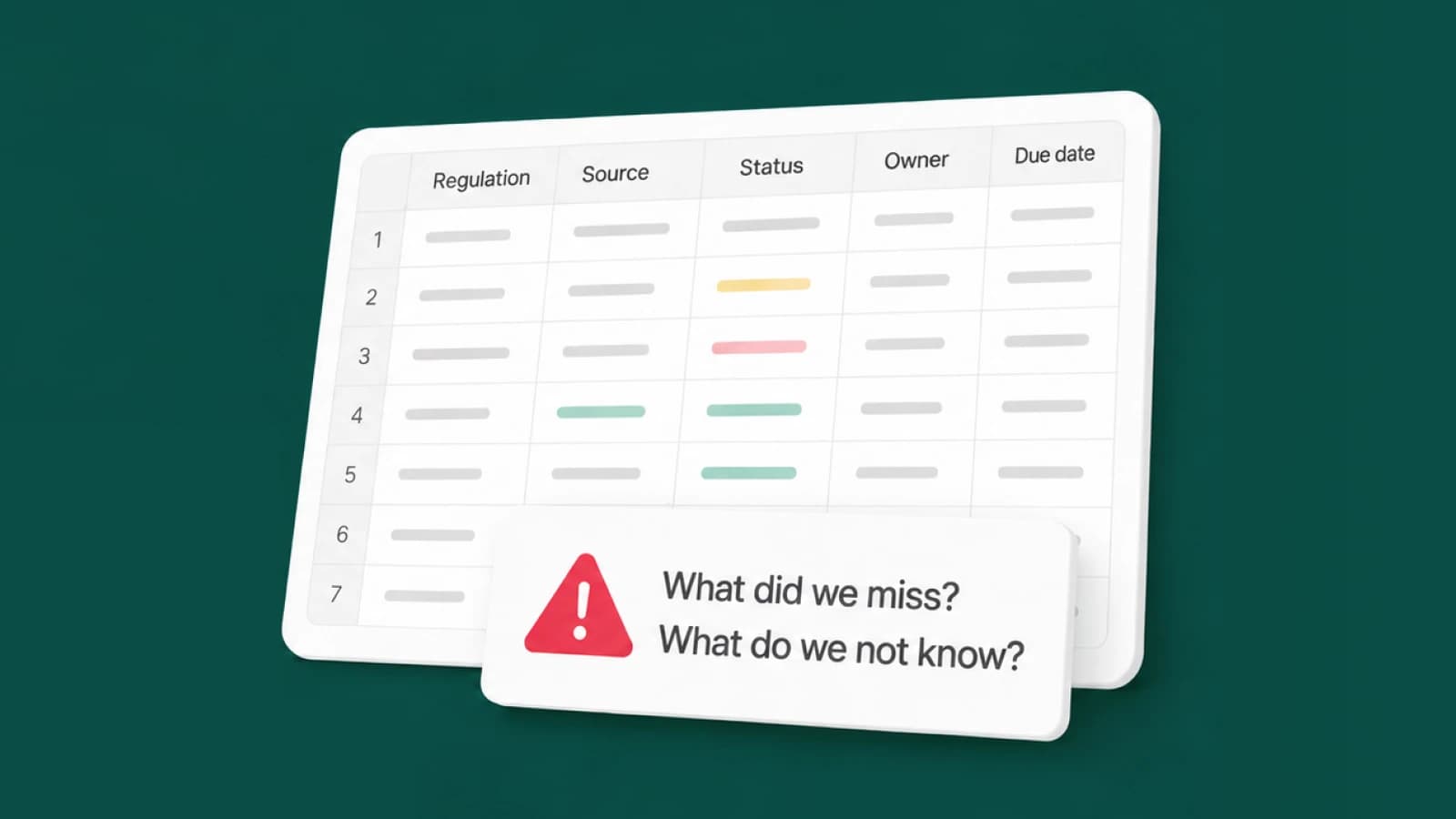
Your team is spending thousands of hours a year tracking regulations, and still can't tell you what they missed.
Most regulatory monitoring processes look fine on a normal week. The failure mode only shows up when something gets missed, and by then nobody can explain why. The real problem has little to do with effort or access to sources. It comes down to a question almost nobody can answer: what did we look at, what did we skip, and how do we know?
We've spent the past year inside dozens of regulatory monitoring workflows: chemicals, consumer products, aerospace, agrochemicals, trade associations, consultancies. The teams are sharp. The tools are not. Here's what manual monitoring actually costs.
Where the time really goes
Monitoring is the kind of task that never shows up in KPIs but quietly eats a team's most senior capacity.
One global chemicals team surveyed twelve internal stakeholders and found they were collectively spending 35 hours a week on monitoring alone. That's close to a full-time role doing nothing but finding information. A trade association lead spends half a day every week working by hand through the Official Journal, ECHA updates, and consultation pages. A flavours and fragrances company with a roughly 120-person regulatory function told us their staff receive the updates but simply "have no sufficient time to read all our news."
The cost accumulates across the whole chain: find the update, read it, decide if it's relevant, decide who owns it, route it, track whether anything happened. Each handoff is manual. Each handoff repeats daily. The compounding is what hurts.
The number that should worry leadership
When we asked one experienced team how confident they were that their process was catching everything material, they rated themselves 5.5 out of 10.
This is a skilled team, actively spending 35 hours a week on the problem, telling you it's roughly a coin flip whether they're missing something that matters.
None of this reflects on the team. The regulatory surface has simply outgrown periodic manual checking. PFAS regulation alone is now active across dozens of US states, each with its own definitions, scope, and timelines. Add EU REACH restrictions, ECHA opinions, sub-national EPR schemes, and the scientific literature that usually moves first, and the monitorable surface is larger than any manual process can credibly cover.
The honest version of most monitoring dashboards is: we are watching the sources we know about, the way we knew how to watch them last year.
Where the spreadsheet falls down
Almost every team we've spoken with tracks regulations in a spreadsheet. One aerospace policy team has been running an Excel tracker since 2014, with manual RSS feeds and a soon-to-be-retired Access database alongside.
A spreadsheet has hard limits, however well it's maintained:
- Updates are static. When a consultation deadline shifts or a bill advances, someone has to notice and edit the row. The tracker doesn't move by itself.
- The cell isn't the source. "REACH restriction: PFAS" doesn't link to the SEAC opinion or the consultation document. Two weeks later, nobody remembers which version they read.
- Collaboration lives elsewhere. Impact assessments, regional feedback, and follow-up actions sit in email threads. The tracker records the signal but not the response.
- You can't audit absence. A blank row could mean "nothing happened" or "we didn't look." There's no way to tell.
That last one is the real issue. A spreadsheet can't tell you what it doesn't know.
One mid-sized chemical company put it plainly: there's no automated correspondence between their newsletters and their ERP system. Every signal has to be cross-referenced by hand against roughly 2,000 raw materials. That isn't a spreadsheet problem. It's a missing-layer problem: there's no system sitting between the source and the substance list.
What this actually costs
The direct figure is large enough on its own. One team estimated that automating monitoring alone could save around €100,000 a year, before counting improved coverage, faster response, or reduced compliance risk.
But the indirect costs are bigger:
- Delayed responses to consultations and comment periods, where the window to influence the rule is fixed and short.
- Reactive compliance instead of proactive risk management: fire-fighting instead of thinking ahead.
- Duplicated effort across regional teams with no shared system.
- A single point of failure, when the one person who holds the mental model goes on leave.
The task has outgrown the tools
The core issue is that the job has outgrown the spreadsheet. Regulatory teams work incredibly hard; the tools haven't kept pace. A working monitoring system needs four things most home-built setups don't have:
- Continuous detection across thousands of sources (agencies, gazettes, trade press, consultations, scientific literature), not periodic manual checks.
- Intelligent filtering that understands your company's products, markets, and substances, rather than matching keywords.
- A workflow layer so signals can be triaged, assigned, and tracked by the right people.
- Coverage transparency so you know what's being monitored, what's been reviewed, and where the gaps are.
The goal isn't to replace expert judgement. It's to make sure experts spend their time on analysis and action, not on finding and formatting information.