
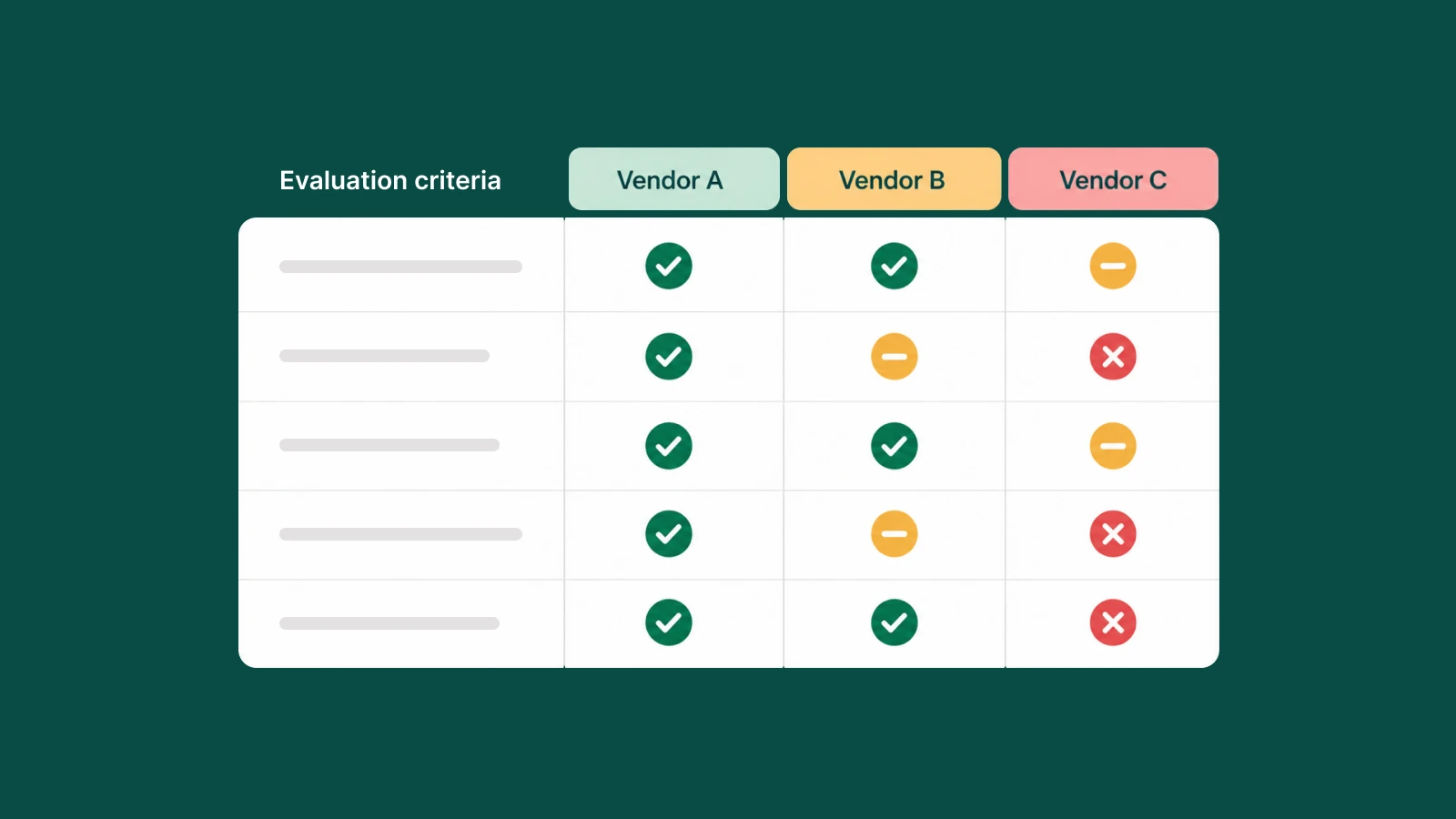
Ten questions to ask any vendor before you commit, drawn from what real buyers wish they'd asked sooner.
"Regulatory intelligence" is a broad label, and every demo looks impressive. The tools underneath solve quite different problems, and the difference rarely shows up in the first call. This guide gives you the questions that do reveal it.
Before you evaluate: know what you're solving for
Four questions for your own team first, because the right tool depends on the answers:
- What does our manual process cost today?
- What coverage do we actually need? Which jurisdictions, domains, and substances are non-negotiable?
- Who will use this, and how? A two-person watch filtering for 120 colleagues has different needs from nine distributed regional specialists.
- What does leadership need to see? If you can't report from it, you'll struggle to keep funding it.
The ten questions
1. What primary sources do you monitor, and can I see the list?
Look for: a documented, inspectable source list.
Red flag: a marketing claim of "global coverage" with no list behind it.
2. How do you handle false negatives, the things you should have caught but didn't?
This is the question that separates serious vendors from confident ones.
Look for: redundancy, source-health monitoring, and a way to request additional source coverage.
Red flag: the suggestion that they never miss anything. Everyone misses things; the honest vendor tells you how they minimise and surface it.
3. Is your filtering keyword-based, or does it understand my company?
Look for: relevance scored against your products, substances, endpoints, and markets: "this matters to you because you're interested in the chemistry, the endpoint, and you've got this product category on the market."
Red flag: keyword matching dressed up as intelligence. The same word means different things in REACH, TSCA, and a state reporting bill.
4. Can I upload my substance portfolio and get alerts when anything changes?
Look for: bulk upload and support for group/structural definitions (PFAS being the obvious test).
One adhesives team's first question was exactly this: "We have all the substances we use in the company. Can we do a mass upload into the substance portfolio?"
Red flag: manual, one-substance-at-a-time entry.
5. What happens after I find a relevant signal?
Look for: triage, assignment, task tracking, resolution: the full "notification → action tracking → risk assessment → completion" loop.
Red flag: the platform stops at the alert.
6. Does the platform learn from my feedback?
Look for: relevance scoring that improves as your team corrects it.
Red flag: static rules that never adapt to your portfolio.
7. How do you handle scientific literature, not just regulatory publications?
Look for: integrated literature monitoring, because "literature → social → news → regulation" is one pipeline and the early signal lives at the front of it.
Red flag: gazettes only; that's monitoring the deadline, not the trend.
8. Can I see exactly where each piece of information came from?
Look for: inline citation to primary source on every alert.
The risk is simple: if an AI summary turns one number into another, your team needs to see the underlying source before it acts.
Red flag: summaries you can't trace back. The moment the summary becomes the artefact instead of the pointer, you've added a new risk.
9. What does reporting look like, and who is it for?
Look for: dashboards aimed at leadership, not just operational views: "we monitored X regulations, identified Y as highly relevant, assigned the right owners, and met Z deadlines."
Red flag: no leadership-facing reporting at all.
10. What does pricing look like, and what's included?
Pricing in this category is rarely apples-to-apples. One quote may be for news access. Another may include regulatory databases, portfolio screening, workflow, reporting, implementation support, and expert review.
Before comparing annual fees, compare the scope of the quote. The useful question is not "which vendor is cheaper?" It is "what job is this price actually covering?"
| If the quote covers | You are probably buying |
|---|---|
| News and expert analysis | Awareness of regulatory change, but not necessarily source coverage, company relevance, or action tracking. |
| Regulatory database access | Searchable information and structured content. Useful, but still dependent on your team to decide what matters. |
| Topic or regional coverage | Coverage may expand one module, topic, country, or region at a time. Ask what happens when your scope grows. |
| Portfolio or substance screening | A relevance layer: the platform should tell you which updates matter to your products, substances, markets, and endpoints. |
| Workflow and reporting | Operational control: assignment, deadlines, audit trails, KPI dashboards, exportable reports, and evidence of action. |
| Managed service or expert review | Additional expert capacity. Valuable, but clarify whether it is included in the subscription or billed separately. |
Ask every vendor to itemise: source coverage, jurisdictions, regions, topics, content types, portfolio matching, literature, substances, users, workflow, reporting, implementation, support, API/export access, and renewal terms. If two quotes do not cover the same list, they are not comparable yet.
Run a structured trial
Demos prove the tool works on the vendor's data. A trial proves it works on yours. Five steps:
- Define success before you start: "Did it increase our confidence that we are not missing important changes?"
- Include multiple users across roles and regions.
- Upload your substance list, not the demo portfolio.
- Check in at the midpoint to course-correct.
- Document the "aha moments" as they happen.
One last principle, and it's the one to hold onto: if a vendor (including us) won't tell you where their system is weakest, that's the answer.