Free exposure report

Get report

Regulation (EU) 2025/40 · Packaging

The Life of
a Package

One PET drinks bottle passes through different hands, duties and regulatory clocks under the EU Packaging and Packaging Waste Regulation.

Who is responsible for a bottle of water?

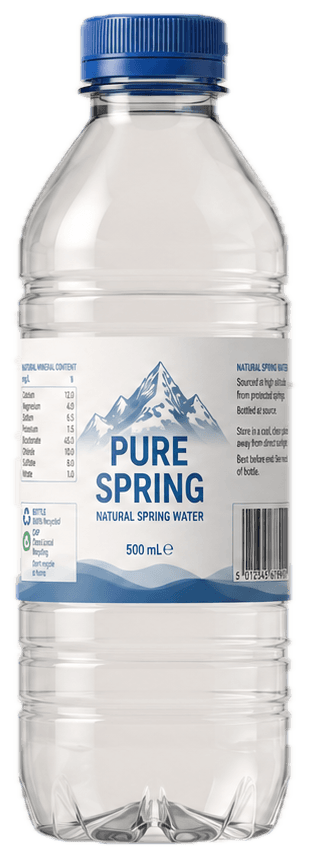
By the time a PET bottle reaches a shelf it has already changed hands several times, and it will change hands again after it is emptied. The EU Packaging and Packaging Waste Regulation follows it the whole way. The same object is regulated repeatedly: as a design, as a chemical product, as a labelled item, as a registered market unit, and finally as material to be recovered.

This issue follows one ordinary bottle through that system. Every requirement shown here is a verified record with its legal basis, duty holder and timing. Where the rules are still being written, the piece says so.

Act 1 / Anatomy

One package, many questions

The bottle is one unit at the point of sale. Its body, closure, label, ink and adhesive do not face the same tests.

What the bottle body must answer

PET, including virgin and recycled content

Provenance15 obligations

Act 2 / Journey

The duty changes hands

Each transfer changes who must know what, verify what and keep which evidence.

10 handovers · the diamonds are selectable, the stages between them are context

  1. Material production
  2. Packaging manufacture
  3. Filling
  4. Import
  5. Distribution
  6. Retail
  7. Consumption
  8. Collection
  9. Sorting
  10. Recycling
  11. Secondary material

Handover 01 of 10

SupplierManufacturer

Material productionPackaging manufacture

The supplier passes component specifications, composition and test evidence into the manufacturer's bottle assessment.

Evidence that moves with it
  • Material and component specifications, test reports, declarations and applicable food-contact documentation in a usable language.
  • Component bill of materials, supplier composition data, substitution rationale and risk-based screening or migration evidence.
  • Material and component declarations, risk-based test reports, recycled-feedstock controls and sampling rationale.
  • Component-level analytical plan, targeted PFAS and total-fluorine results, precursor evidence where required, and fluorine attribution above the trigger.
Provenance23 obligations

Act 3 / Lenses

Five readings of the same bottle

Design, chemistry, circularity, information and market access reveal different obligations without changing the object.
Read the bottle through one lens

Material, format and minimisation requirements.
11 obligations in this lens · point at one to see where it lands

Provenance38 obligations

Act 4 / Time

The clocks do not start together

Some duties have fixed dates. Others wait for technical rules, split into phases or depend on national systems.
Fixed
The legal text gives a fixed application date.
Dependent
Application waits for a named secondary measure.
In development
The technical rule is still being developed.
Split
The obligation changes through more than one dated step.
Member State
Operation depends on national implementation or systems.

Reading the bottle in 2026

Design and minimisation

  • Use no more bottle material than necessaryArticle 10(1) and (4)Not yet applicable
  • Do not add features that only make the pack look largerArticle 10(2) and (4)Not yet applicable
  • Keep bottle headspace to what the drink needsArticle 24(4)Not yet applicable
  • Limit empty space around bottles in outer packagingArticle 24(1) to (3) and (5)Not yet applicable
  • Do not wrap bottle multipacks in plastic just to encourage multi-buy salesArticle 25(1) and (6)Not yet applicable

Recyclability

  • Meet the recyclability grade needed for market accessArticle 6(1) to (4) and (9)Not yet applicable
  • Make every bottle component compatible with recyclingArticle 6(4) and (9)Not yet applicable
  • Show that the PET bottle is recycled at scaleArticle 3(39)Not yet applicable

Recycled content

  • Increase recycled plastic in the bottle over timeArticle 7(1)(c), (2)(c), (5), (6), (8) and (11)Not yet applicable
  • Calculate recycled content on the required production basisArticle 7(1), (8) and (11)Not yet applicable
  • Apply equivalent controls to imported bottles and recyclateArticle 7(3), (6) and (10)Not yet applicable
  • Use recycled plastic from qualifying recycling technologiesArticle 7(9)Not yet applicable

Substances

  • Minimise substances of concern across the bottleArticle 5(1)Applicable
  • Keep four heavy metals below the combined limitArticle 5(4), (6) to (8)Applicable
  • Keep PFAS below the food-contact packaging limitsArticle 5(5) and (6)Applicable

Labelling and information

  • Use the harmonised material label when the bottle is outside a DRSArticle 12(1), (5) to (7) and (12)Not yet applicable
  • Mark a covered bottle for the deposit-return systemArticle 12(1), (5), (6) and (12)Not yet applicable
  • Make required bottle information clear before purchaseArticle 12(5)Not yet applicable
  • Digitally identify substances of concern in bottle materialsArticle 12(1) and (7)Awaiting secondary measure

Conformity and documentation

  • Pass compliance information from each component supplierArticle 16Applicable
  • Assess the complete bottle and build its technical fileArticle 15(1) to (4)Applicable
  • Sign and maintain the EU declaration of conformityArticle 15(2) and (3)Applicable
  • Keep production and the technical file in stepArticle 15(4) to (7)Applicable
  • Stop an imported bottle until its evidence is completeArticle 18Applicable
  • Check bottle information before making it availableArticle 19Applicable
  • Correct non-compliance and preserve the supply trailArticle 15(8) and (10)Applicable

Producer responsibility and market

  • Identify and register the producer in every destination marketArticle 3(15)Applicable
  • Report bottle quantities in each Member StateArticle 44(7) to (10)Applicable
  • Finance or organise the bottle's end-of-life systemArticle 45(1) and (2)Applicable
  • Pay EPR fees that reflect bottle performanceArticle 6(4)(d) and (8)Awaiting secondary measure
  • Appoint an EPR representative for direct cross-border salesArticle 3(20)Applicable

Deposit and return

  • Provide a deposit-return route for covered bottlesArticle 50(1), (2) and (5) to (7)Not yet applicable
  • Charge the applicable deposit when the bottle is soldArticle 50(2) to (5)Not yet applicable
  • Take back covered bottles and refund the depositArticle 50(11)Not yet applicable

Collection and recycling

  • Provide a route to collect the bottle separatelyArticle 48(1), (3) and (5)Applicable
  • Fund enough capacity to sort and recycle collected bottlesArticle 47(3)Applicable
  • Count PET as recycled only when it enters the recycling operationArticle 52(1)(d)(i)Not yet applicable
  • Preserve the data chain from collection to recyclingArticle 23Awaiting secondary measure
Article 7(1)(c), (2)(c), (5), (6), (8) and (11)Increase recycled plastic in the bottle over time
20252030204030%65%
  • 2030: The PPWR start is subject to a later trigger linked to the calculation-method act.
Article 7(3), (6) and (10)Apply equivalent controls to imported bottles and recyclate
202520302040Equivalent controls for the 30% phaseEquivalent controls for the 65% phase
  • 2030: Subject to the same later trigger as the bottle target.

The same duties in plain date order

  1. From 12 Aug 2026
    Minimise substances of concern across the bottleArticle 5(1)
  2. From 12 Aug 2026
    Keep four heavy metals below the combined limitArticle 5(4), (6) to (8)Annex VII
  3. From 12 Aug 2026
    Keep PFAS below the food-contact packaging limitsArticle 5(5) and (6)Annex VII
  4. From 12 Aug 2026
    Pass compliance information from each component supplierArticle 16
  5. From 12 Aug 2026
    Assess the complete bottle and build its technical fileArticle 15(1) to (4)Article 38Annex VII
  6. From 12 Aug 2026
    Sign and maintain the EU declaration of conformityArticle 15(2) and (3)Article 39Annexes VII and VIII
  7. From 12 Aug 2026
    Keep production and the technical file in stepArticle 15(4) to (7)Annex VII
  8. From 12 Aug 2026
    Stop an imported bottle until its evidence is completeArticle 18Annex VII
  9. From 12 Aug 2026
    Check bottle information before making it availableArticle 19
  10. From 12 Aug 2026
    Correct non-compliance and preserve the supply trailArticle 15(8) and (10)Article 18(6), (8) and (9)Article 19(3), (5) and (6)Article 22
  11. From 12 Aug 2026
    Identify and register the producer in every destination marketArticle 3(15)Article 44(1) to (6)Annex IX, Part A
  12. From 12 Aug 2026
    Report bottle quantities in each Member StateArticle 44(7) to (10)Annex IX, Part B
  13. From 12 Aug 2026
    Finance or organise the bottle's end-of-life systemArticle 45(1) and (2)Articles 46 and 47
  14. From 12 Aug 2026
    Appoint an EPR representative for direct cross-border salesArticle 3(20)Article 45(3)
  15. From 12 Aug 2026
    Provide a route to collect the bottle separatelyArticle 48(1), (3) and (5)Article 49
  16. From 12 Aug 2026
    Fund enough capacity to sort and recycle collected bottlesArticle 47(3)Article 48(1), (2) and (5)
  17. Awaiting: Calculation, verification and submission of packaging-waste data
    Preserve the data chain from collection to recyclingArticle 23Article 44(10)Article 56(2) to (7)Annex IX, Part B(3)Annex XII
  18. From 12 Feb 2028
    Keep bottle headspace to what the drink needsArticle 24(4)Article 35
  19. No earlier than 12 Aug 2028, awaiting: Harmonised packaging labels, DRS marking and data-carrier specifications
    Use the harmonised material label when the bottle is outside a DRSArticle 12(1), (5) to (7) and (12)
  20. No earlier than 12 Aug 2028, awaiting: Harmonised packaging labels, DRS marking and data-carrier specifications
    Mark a covered bottle for the deposit-return systemArticle 12(1), (5), (6) and (12)Article 50(1), (2), (4), (5) and (9)
  21. No earlier than 12 Aug 2028, awaiting: Harmonised packaging labels, DRS marking and data-carrier specifications
    Make required bottle information clear before purchaseArticle 12(5)
  22. No earlier than 1 Jan 2029, awaiting: Calculation, verification and documentation of recycled plastic content
    Calculate recycled content on the required production basisArticle 7(1), (8) and (11)Annex VII
  23. From 1 Jan 2029
    Provide a deposit-return route for covered bottlesArticle 50(1), (2) and (5) to (7)
  24. From 1 Jan 2029
    Charge the applicable deposit when the bottle is soldArticle 50(2) to (5)Annex X
  25. From 1 Jan 2029
    Take back covered bottles and refund the depositArticle 50(11)Annex X(l) and (m)
  26. From 1 Jan 2030
    Use no more bottle material than necessaryArticle 10(1) and (4)Annex IVAnnex VII
  27. From 1 Jan 2030
    Do not add features that only make the pack look largerArticle 10(2) and (4)Article 70(1)(b)Annex IVAnnex VII
  28. No earlier than 1 Jan 2030, awaiting: Method for calculating empty-space ratios
    Limit empty space around bottles in outer packagingArticle 24(1) to (3) and (5)
  29. From 1 Jan 2030
    Do not wrap bottle multipacks in plastic just to encourage multi-buy salesArticle 25(1) and (6)Annex V, point 1
  30. No earlier than 1 Jan 2030, awaiting: Design-for-recycling criteria, assessment method and recyclability grades
    Meet the recyclability grade needed for market accessArticle 6(1) to (4) and (9)Annex II, Tables 1, 3 and 4
  31. No earlier than 1 Jan 2030, awaiting: Design-for-recycling criteria, assessment method and recyclability grades
    Make every bottle component compatible with recyclingArticle 6(4) and (9)Annex II, Table 4
  32. Steps from 1 Jan 2030 to 1 Jan 2040
    Increase recycled plastic in the bottle over timeArticle 7(1)(c), (2)(c), (5), (6), (8) and (11)Article 67(2)Annex VII
  33. Steps from 1 Jan 2030 to 1 Jan 2040
    Apply equivalent controls to imported bottles and recyclateArticle 7(3), (6) and (10)Article 18Annex VII
  34. No earlier than 1 Jan 2030, awaiting: Sustainability criteria for plastic recycling technologies
    Use recycled plastic from qualifying recycling technologiesArticle 7(9)
  35. Awaiting: Digital identification of substances of concern in packaging materials
    Digitally identify substances of concern in bottle materialsArticle 12(1) and (7)
  36. Awaiting: Assessment of recycling at scale, thresholds and chain of custody
    Pay EPR fees that reflect bottle performanceArticle 6(4)(d) and (8)Article 7(7)Article 45(1)
  37. From 31 Dec 2030
    Count PET as recycled only when it enters the recycling operationArticle 52(1)(d)(i)Article 53(3) to (6)
  38. No earlier than 1 Jan 2035, awaiting: Assessment of recycling at scale, thresholds and chain of custody
    Show that the PET bottle is recycled at scaleArticle 3(39)Article 6(2), (3), (5) and (9)Annex II, Tables 2 and 3
Provenance38 obligations

One bottle carries 38 verified obligations across seven components, ten handovers and five regulatory clocks. Your portfolio is not one bottle.

See your packaging read this way →Book a demo and see how the same regulatory record works inside Foresight, continuously, for every product you place on the market.
Sources and methodologyHow this issue was researched.38 obligations · 6 sources · 9 recorded gaps

The Foresight Assistant searched the regulatory record and connected related files. It is a research lead, never a citable source: every published obligation was verified against the final Official Journal text of Regulation (EU) 2025/40 or official Commission material, and carries its legal basis, source and verification date.

Requirements that fall outside one PET drinks bottle's path, or that could not be verified to that standard, are held back as explicit gaps rather than published. Secondary measures appear only where a published obligation depends on them, with their official status at the verification date. This is an editorial instrument, not legal advice.

Recorded gaps

  • Excluded because the candidate restriction depends on a beverage being filled and consumed within HORECA premises, not the ordinary factory-filled PET bottle journey.
  • Excluded because the selected bottle is single-use and must not be presented as reusable without a qualifying re-use system.
  • Excluded because the candidate 10% duty applies to a final distributor's beverage portfolio, not a conversion requirement for the selected single-use bottle.
  • Excluded because reporting follows the portfolio reuse target and does not create a bottle-level duty.
  • Excluded because refill duties require an operator to offer refill or operate a refill station, which the chosen pre-filled bottle journey does not establish.
  • Excluded because the candidate targets concern grouped or transport packaging, not the individual bottle as consumer sales packaging.
  • Excluded because take-back within a re-use system governs reusable beverage packaging, not the selected single-use bottle.
  • Excluded because HORECA takeaway refill and reusable-container duties sit outside the chosen factory-filled retail bottle journey.
  • Merged into producer registration and distributor gatekeeping because the final OJ does not create a separate retention duty for registration evidence.

Update history

Dataset verified 24 Jul 2026. No revisions recorded since.

Regulation (EU) 2025/40 · Packaging and Packaging Waste Regulation

Annex II, Table 4

Annex II, Table 4Non-exhaustive list of parameters for setting design for recycling criteria under Article 6

The list in this Table shall be used as a basis when defining design for recycling criteria, as set out in Article 6(4). The design for recycling criteria shall then be used in order to set the calculations leading to the performance grades listed in Table 3. In addition, the assessment of the parameters set out in that list shall consider:

— separability of any component of packaging, either manually by end users or in processing plants,

— efficiency of sorting and recycling processes, for example yield,

— evolution of sorting and recycling technologies (to address the aspect if the packaging cannot be sorted today, but it might be sortable in 2 years), and

— preservation of functionality of secondary raw materials enabling the substitution of primary raw materials.

The packaging functionality that the following parameters provide to the packaging shall be factored-in in the setting of design for recycling criteria.

Parameters for design for recycling criteriaParameter’s relevance
AdditivesAdditives refer often to substances added to materials to confer specific properties. The presence of additives in the packaging containers can result in incorrect sorting of the packaging materials during the sorting process and can contaminate the obtained secondary raw materials.
LabelsCoverage rate of labels can affect the efficiency of the sorting process. Material from which the label is made and type of glue or adhesive also affect the quality of the secondary raw material.
SleevesCoverage rate of the sleeve on the main packaging body affects the possibilities for sorting. In addition, the use of sleeves can affect the ability to separate them from the main packaging body. The material from which the sleeve is made can affect both the sortability and the recyclability of the packaging.
Closures and other small packaging componentsClosures refer to components used to close or seal the packaging. There may be different types of closures, rigid or flexible, such as tamper-evident shrink wrap, linings, caps, lids, seals, valves, etc. The material from which the closures is made can affect both the sortability and the recyclability of the packaging. Closures that are not firmly attached to the packaging can increase litter. Small packaging components attached to the main packaging body can affect the separability and the recyclability of the packaging. In addition, the components can be lost in the sorting and recycling process.
AdhesivesAdhesives can be used in such a way that they can be easily separated in the recycling process or by the end user or in a way that they do not affect the efficiency of the sorting and recycling processes. The presence of adhesive residues on the packaging can downgrade the quality (purity) of the secondary raw materials. Washable adhesives can ensure the separation from the main packaging body and that no adhesive residue remains in the secondary raw material.
ColoursColours are substances that impart colour to the packaging material. Heavily dyed materials in paper or plastics can cause problems with regard to sorting and can downgrade the quality of secondary raw materials.
Material compositionUse of mono-materials or material combinations that permit easy separation and ensure high yield of secondary raw materials is preferable.
Barriers / coatingsThe material or substance added to confer barrier properties (barrier), or a variety of materials applied on the surface to impart other properties (coating). The presence of barriers or coatings within the packaging can make recycling more difficult. Combinations that ensure high yield of secondary raw materials are preferable.
Inks and lacquers / printing/ codingInks and lacquers are mixtures of colorants with other substances applied onto the material by a printing or coating process (ink) or a protective coating made of resin or cellulose ester, or both, dissolved in a volatile solvent (lacquer). Coding refers to printing applied directly to sales packaging for the purpose of batch coding and other information and branding. The use of inks with substances of concern hinders recycling, as those packaging units cannot be recycled. Printing inks when released can contaminate the recycling stream through the washing water. Likewise, printing inks which are not released can impair the transparency of the recycling stream.
Product residues / ease of emptyingResidues of the content of the packaging can affect the sortability and the recyclability of the packaging. The design of the packaging should enable the easy emptying of its content and when disposed of should be in a fully drained condition.
Ease of dismantlingComponents that are firmly attached to each other can affect the sortability and the recyclability of the packaging. Packaging design can facilitate the possibility of separating different components into different material streams.

( 1 ) Please note that this category contains plastics that are readily biodegradable (meaning a proven ability to convert >90 % of the original material into CO 2 , water and minerals by biological processes within 6 months) and regardless of the feedstock used for their production. Biobased polymers that are not readily biodegradable are covered under the other relevant plastic categories.

Read on EUR-Lex ↗

Regulation (EU) 2025/40 · Packaging and Packaging Waste Regulation

Annex II, Tables 1, 3 and 4

Annex II, Table 1Indicative list of packaging materials, types and categories referred to in Article 6

Category NoPredominant packaging materialPackaging typeFormat (illustrative and non-exhaustive)Colour / Optical transmittance
1GlassGlass and composite packaging, of which the majority is glassBottles, jars, flacons, cosmetics pots, tubs, ampoules, vials made of glass (soda lime silica), aerosol cans
2Paper/cardboardPaper/cardboard packagingBoxes, trays, grouped packaging, flexible paper packaging (e.g. films, sheets, pouches, lidding, cones, wrappers)
3Paper/cardboardComposite packaging of which the majority is paper/cardboardLiquid packaging board, and paper cups (i.e. laminated with polyolefin and with or without aluminium), trays, plates and cups, metallised or plastic laminated paper/cardboard, paper/cardboard with plastic liners/ windows
4MetalSteel and composite packaging of which the majority is steelRigid formats (aerosols cans, cans, paint tins, boxes, trays, drums, tubes) made of steel, including tinplate and stainless steel
5MetalAluminium and composite packaging of which the majority is aluminium – rigidRigid formats (food and beverage cans, bottles, aerosols, drums, tubes, cans, boxes, trays) made of aluminium
6MetalAluminium and composite packaging of which the majority is aluminium – semi-rigid and flexibleSemi rigid and flexible formats (containers and trays, tubes, foils, flexible foil) made of aluminium
7PlasticPET – rigidBottles and flasksTransparent clear / coloured, opaque
8PlasticPET – rigidRigid formats other than bottles and flasks (including pots, tubs, jars, cups, mono- and multilayer trays and containers, aerosol cans)Transparent clear / coloured, opaque
9PlasticPET – flexibleFilmsNatural / coloured
10PlasticPE – rigidContainers, bottles, trays, pots and tubesNatural / coloured
11PlasticPE – flexibleFilms, including multilayer and multi-material packagingNatural / coloured
12PlasticPP – rigidContainers, bottles, trays, pots and tubesNatural / coloured
13PlasticPP – flexibleFilms, including multilayer and multi-material packagingNatural / coloured
14PlasticHDPE and PP – rigidCrates and pallets, corrugated board plasticNatural / coloured
15PlasticPS and XPS – rigidRigid formats (including dairy packaging, trays, cups and other food containers)Natural / coloured
16PlasticEPS – rigidRigid formats (including fish boxes / white goods and trays)Natural / coloured
17PlasticOther rigid plastics (e.g. PVC, PC) including multi-materials – rigidRigid formats, including. intermediate bulk containers, drums
18PlasticOther flexible plastics including multi-materials – flexiblePouches, blisters, thermoformed packaging, vacuum packaging, modified atmosphere/modified humidity packaging, including flexible intermediate bulk containers, bags, stretch films
19PlasticBiodegradable plastics – rigid (e.g. PLA, PHB) and flexible (e.g. PLA)Rigid and flexible formats
20Wood, corkWooden packaging, including corkPallets, boxes, crates
21TextileNatural and synthetic textile fibresBags
22Ceramics or porcelain stonewareClay, stonePots, containers, bottles, jars
Read on EUR-Lex ↗

Annex II, Table 3Recyclability performance grades

Packaging recyclability shall be expressed in the performance grades A, B or C.

From 2030, recyclability performance is based on design for recycling criteria. The design for recycling criteria shall ensure the circularity of the use of the resulting secondary raw materials of sufficient quality to substitute the primary raw materials.

The assessment based on design for recycling criteria shall be carried out for each packaging category listed in Table 1, taking into account the methodology established under Article 6(4) and the related delegated acts, as well as the parameters established in Table 4. After weighing the criteria per packaging unit, it will be classified into categories A, B or C. When a packaging unit’s recyclability performance grade is below 70 %, it is considered to be non-compliant with the recyclability performance grades and therefore the packaging will be considered technically non-recyclable and its placing on the market shall be restricted.

From 2035, a new factor shall be added to the assessment of the packaging recyclability, which is the recycled-at-scale assessment. Consequently, a new assessment shall be carried out based on the quantity (weight) of the material effectively recycled from each of the packaging categories in accordance with the methodology established in the implementing acts adopted under Article 6(5). The thresholds related to the annual recycled packaging materials for compliance with the recycled-at-scale assessment shall be defined taking into account the targets set in Article 3(1), point (39).

203020352038
Recyclability performance gradeDesign for recycling (DfR) Assessment of recyclability per unit, in terms of weightingRecyclability performance grade (for DfR)Design for recycling (DfR) Assessment of recyclability per unit, in terms of weightingRecyclability performance grade (for recycled-at-scale assessment)Recyclability performance gradeDesign for recycling (DfR) Assessment of recyclability per unit, in terms of weightingRecyclability performance grade (for recycled-at-scale assessment)
Grade Ahigher or equal to 95 %Grade Ahigher or equal to 95 %Grade A RaSGrade Ahigher or equal to 95 %Grade A RaS
Grade Bhigher or equal to 80 %Grade Bhigher or equal to 80 %Grade B RaSGrade Bhigher or equal to 80 %Grade B RaS
Grade Chigher or equal to 70 %Grade Chigher or equal to 70 %Grade C RaSGrade C CANNOT BE PLACED ON THE MARKEThigher or equal to 70 %Grade C RaS
TECHNICALLY NON-RECYCLABLElower than 70 %TECHNICALLY NON-RECYCLABLElower than 70 %NOT RECYCLED AT SCALE (below thresholds of Article 3(1), point (39).TECHNICALLY NON-RECYCLABLElower than 70 %NOT RECYCLED AT SCALE (below thresholds of Article 3(1), point (39).
Read on EUR-Lex ↗

Annex II, Table 4Non-exhaustive list of parameters for setting design for recycling criteria under Article 6

The list in this Table shall be used as a basis when defining design for recycling criteria, as set out in Article 6(4). The design for recycling criteria shall then be used in order to set the calculations leading to the performance grades listed in Table 3. In addition, the assessment of the parameters set out in that list shall consider:

— separability of any component of packaging, either manually by end users or in processing plants,

— efficiency of sorting and recycling processes, for example yield,

— evolution of sorting and recycling technologies (to address the aspect if the packaging cannot be sorted today, but it might be sortable in 2 years), and

— preservation of functionality of secondary raw materials enabling the substitution of primary raw materials.

The packaging functionality that the following parameters provide to the packaging shall be factored-in in the setting of design for recycling criteria.

Parameters for design for recycling criteriaParameter’s relevance
AdditivesAdditives refer often to substances added to materials to confer specific properties. The presence of additives in the packaging containers can result in incorrect sorting of the packaging materials during the sorting process and can contaminate the obtained secondary raw materials.
LabelsCoverage rate of labels can affect the efficiency of the sorting process. Material from which the label is made and type of glue or adhesive also affect the quality of the secondary raw material.
SleevesCoverage rate of the sleeve on the main packaging body affects the possibilities for sorting. In addition, the use of sleeves can affect the ability to separate them from the main packaging body. The material from which the sleeve is made can affect both the sortability and the recyclability of the packaging.
Closures and other small packaging componentsClosures refer to components used to close or seal the packaging. There may be different types of closures, rigid or flexible, such as tamper-evident shrink wrap, linings, caps, lids, seals, valves, etc. The material from which the closures is made can affect both the sortability and the recyclability of the packaging. Closures that are not firmly attached to the packaging can increase litter. Small packaging components attached to the main packaging body can affect the separability and the recyclability of the packaging. In addition, the components can be lost in the sorting and recycling process.
AdhesivesAdhesives can be used in such a way that they can be easily separated in the recycling process or by the end user or in a way that they do not affect the efficiency of the sorting and recycling processes. The presence of adhesive residues on the packaging can downgrade the quality (purity) of the secondary raw materials. Washable adhesives can ensure the separation from the main packaging body and that no adhesive residue remains in the secondary raw material.
ColoursColours are substances that impart colour to the packaging material. Heavily dyed materials in paper or plastics can cause problems with regard to sorting and can downgrade the quality of secondary raw materials.
Material compositionUse of mono-materials or material combinations that permit easy separation and ensure high yield of secondary raw materials is preferable.
Barriers / coatingsThe material or substance added to confer barrier properties (barrier), or a variety of materials applied on the surface to impart other properties (coating). The presence of barriers or coatings within the packaging can make recycling more difficult. Combinations that ensure high yield of secondary raw materials are preferable.
Inks and lacquers / printing/ codingInks and lacquers are mixtures of colorants with other substances applied onto the material by a printing or coating process (ink) or a protective coating made of resin or cellulose ester, or both, dissolved in a volatile solvent (lacquer). Coding refers to printing applied directly to sales packaging for the purpose of batch coding and other information and branding. The use of inks with substances of concern hinders recycling, as those packaging units cannot be recycled. Printing inks when released can contaminate the recycling stream through the washing water. Likewise, printing inks which are not released can impair the transparency of the recycling stream.
Product residues / ease of emptyingResidues of the content of the packaging can affect the sortability and the recyclability of the packaging. The design of the packaging should enable the easy emptying of its content and when disposed of should be in a fully drained condition.
Ease of dismantlingComponents that are firmly attached to each other can affect the sortability and the recyclability of the packaging. Packaging design can facilitate the possibility of separating different components into different material streams.

( 1 ) Please note that this category contains plastics that are readily biodegradable (meaning a proven ability to convert >90 % of the original material into CO 2 , water and minerals by biological processes within 6 months) and regardless of the feedstock used for their production. Biobased polymers that are not readily biodegradable are covered under the other relevant plastic categories.

Read on EUR-Lex ↗

Regulation (EU) 2025/40 · Packaging and Packaging Waste Regulation

Annex II, Tables 2 and 3

Annex II, Table 2Indicative list of packaging materials and categories referred to in Article 6

MaterialsCategoriesLink to Table 1, Annex II
PlasticPET rigidcategories 7, 8
PE rigid, PP rigid, HDPE and PP rigidcategories 10, 12, 14
Films/flexiblecategories 9, 11, 13, 18
PS, XPS, EPScategories 15, 16
Other rigid plasticscategory 17
Biodegradable (rigid and flexible)category 19
Paper/cardboardPaper/cardboard (except liquid packaging board)categories 2, 3
Liquid packaging boardcategory 3
MetalAluminiumcategories 5, 6
Steelcategory 4
GlassGlasscategory 1
WoodWood, corkcategory 20
OthersTextile, ceramics/porcelain and otherscategories 21, 22
Read on EUR-Lex ↗

Annex II, Table 3Recyclability performance grades

Packaging recyclability shall be expressed in the performance grades A, B or C.

From 2030, recyclability performance is based on design for recycling criteria. The design for recycling criteria shall ensure the circularity of the use of the resulting secondary raw materials of sufficient quality to substitute the primary raw materials.

The assessment based on design for recycling criteria shall be carried out for each packaging category listed in Table 1, taking into account the methodology established under Article 6(4) and the related delegated acts, as well as the parameters established in Table 4. After weighing the criteria per packaging unit, it will be classified into categories A, B or C. When a packaging unit’s recyclability performance grade is below 70 %, it is considered to be non-compliant with the recyclability performance grades and therefore the packaging will be considered technically non-recyclable and its placing on the market shall be restricted.

From 2035, a new factor shall be added to the assessment of the packaging recyclability, which is the recycled-at-scale assessment. Consequently, a new assessment shall be carried out based on the quantity (weight) of the material effectively recycled from each of the packaging categories in accordance with the methodology established in the implementing acts adopted under Article 6(5). The thresholds related to the annual recycled packaging materials for compliance with the recycled-at-scale assessment shall be defined taking into account the targets set in Article 3(1), point (39).

203020352038
Recyclability performance gradeDesign for recycling (DfR) Assessment of recyclability per unit, in terms of weightingRecyclability performance grade (for DfR)Design for recycling (DfR) Assessment of recyclability per unit, in terms of weightingRecyclability performance grade (for recycled-at-scale assessment)Recyclability performance gradeDesign for recycling (DfR) Assessment of recyclability per unit, in terms of weightingRecyclability performance grade (for recycled-at-scale assessment)
Grade Ahigher or equal to 95 %Grade Ahigher or equal to 95 %Grade A RaSGrade Ahigher or equal to 95 %Grade A RaS
Grade Bhigher or equal to 80 %Grade Bhigher or equal to 80 %Grade B RaSGrade Bhigher or equal to 80 %Grade B RaS
Grade Chigher or equal to 70 %Grade Chigher or equal to 70 %Grade C RaSGrade C CANNOT BE PLACED ON THE MARKEThigher or equal to 70 %Grade C RaS
TECHNICALLY NON-RECYCLABLElower than 70 %TECHNICALLY NON-RECYCLABLElower than 70 %NOT RECYCLED AT SCALE (below thresholds of Article 3(1), point (39).TECHNICALLY NON-RECYCLABLElower than 70 %NOT RECYCLED AT SCALE (below thresholds of Article 3(1), point (39).
Read on EUR-Lex ↗

Regulation (EU) 2025/40 · Packaging and Packaging Waste Regulation

Annex IV

Annex IV, Part APerformance criteria

1. Product protection: packaging design shall ensure protection of the product, from the point of packaging or filling until its end use, with a view to preventing significant product damage, loss, deterioration or waste. Requirements may consist of protection against mechanical or chemical damage, vibration, compression, humidity, moisture loss, oxidation, light, oxygen, microbiological infection, pest, deterioration of organoleptic properties, etc. and include references to specific Union law setting out requirements on product quality.

2. Packaging manufacturing processes: the packaging design shall be compatible with the packaging manufacturing and filling processes. The packaging manufacturing processes may determine packaging design elements, such as the shape of a container, thickness tolerances, size, feasibility of tooling, or specifications minimising waste in manufacturing. The processes operated by manufacturer of products may also require certain design elements of packaging, such as impact and stress resistance, mechanical strength, packing line speed and efficiency, stability in conveying, heat resistance, effective closing, minimum headspace, or hygiene.

3. Logistics: the packaging design shall ensure adequate and safe distribution, transport, handling and warehousing of the packaged product. Requirements may consist of dimensional coordination for optimum space utilisation, compatibility with palletising and de-palletising systems, handling and warehousing system, and packaging system integrity during transport and handling.

4. Packaging functionality: the packaging design shall ensure its functionality, taking into account the purpose of the product and particularities giving rise to its sale, such as sales for gift purposes, or on the occasion of seasonal events.

5. Information requirements: the packaging design shall ensure that any necessary information regarding the packaged product itself, its use, storage and care, including safety instructions, can be provided to end users. Requirements may include providing product information, instructions for storage, application and use, bar codes and the best before date.

6. Hygiene and safety: the packaging design shall ensure user and consumer safety as well as product safety and hygiene throughout the distribution, end use and disposal of the packaged product. Requirements may include those on safe handling design, child resistance, anti-tamper, anti-theft, anti-counterfeit, hazard warnings, clear identification of content, safe opening device or pressure-release closure.

7. Legal requirements: the packaging design shall ensure that the packaging and packaged product can comply with applicable law.

8. Recycled content, recyclability and re-use: the packaging design shall ensure reusability, recyclability and inclusion of recycled content as required under this Regulation. If the packaging is intended for re-use, it shall fulfil the requirements laid down in Article 11(1). This means that the packaging weight or volume may have to be increased beyond what would otherwise be possible under the other performance factors in order to enable for example a higher number of trips or rotations, to facilitate inclusion of recycled content or to enhance recyclability (for example when moving to a mono-material or post-consumer recycled content).

Read on EUR-Lex ↗

Annex IV, Part BAssessment methodology and determination of the minimum packaging volume and weight

The assessment of the minimum packaging volume and weight necessary to ensure the packaging functionality as described in Article 3(1), point (1), shall be explained in the technical documentation and shall include at least:

(a) the description of the outcome of the assessment, including the details of the calculation of the minimum necessary weight and volume for the packaging; possible variations between production batches for a same packaging shall be taken into account and documented;

(b) for each performance criterion as listed in Part A, a description which explains the design requirement that prevents further reduction of the packaging weight or volume without endangering the packaging functionality, including safety and hygiene, for the packaged product, packaging and user; the method used for the identification of these design requirements shall be described, and the reasons preventing further reduction of the packaging weight or volume shall be explained; all reduction opportunities with a given packaging material shall be investigated, such as the reduction of any superfluous layer which does not perform a packaging function; substitution of one packaging material with another shall not be considered sufficient;

(c) any test results, market research or studies that have been used for the assessment conducted under points (a) and (b).

Read on EUR-Lex ↗

Regulation (EU) 2025/40 · Packaging and Packaging Waste Regulation

Annex IX, Part A

Annex IX, Part AInformation to be submitted upon registration

1. The information to be submitted by the producer or its authorised representative for extended producer responsibility shall include: (a) name and brand names (if available) under which the producer makes its packaging, including packaging of packaged products, available on the territory of the Member State and address of the producer, including postal code and place, street and number, country, telephone, if any, web address and e-mail address, indicating a single contact point; (b) where a producer has authorised an authorised representative with carrying out the extended producer responsibility obligations on its behalf, in addition to the information referred in point (a): name and address including postal code and place, street and number, country, telephone and e-mail address of the authorised representative; (c) national identification code of the producer, including its trade register number or equivalent official registration number and the European or national tax identification number; (d) a declaration on how the producer meets its responsibilities under Article 45, including a certificate issued by the producer responsibility organisation where Article 46(1) applies.

2. Where a producer responsibility organisation is entrusted with carrying out the extended producer responsibility obligations, the information to be provided by the producer shall include the name and contact details, including postal code and place, street and number, country, telephone, web address and e-mail address and the national identification code of the producer responsibility organisation, including the trade register number or an equivalent official registration number and the European or national tax identification number of the producer responsibility organisation, the represented producer’s mandate, and a statement by the producer or, where applicable, producer’s authorised representative for the extended producer responsibility or the producer responsibility organisation stating that the information provided is true.

3. Where a producer responsibility organisation that has been entrusted with carrying out the extended producer responsibility obligations by the producer as referred to in Article 46(1), carries out the obligation to register set out in Article 44, it shall, in addition to the information required under point 1 of this Part, provide: (a) the names and contact details, including postal codes and places, streets and numbers, countries, telephones, web addresses and e-mail addresses of the producers represented; (b) the mandate of each represented producer, where applicable; (c) where the producer responsibility organisation represents more than one producer, a separate indication of how each one of the represented producers meets the responsibilities set out in Article 45.

Read on EUR-Lex ↗

Regulation (EU) 2025/40 · Packaging and Packaging Waste Regulation

Annex IX, Part B

Annex IX, Part BInformation to be submitted for reporting

1. Information to be submitted for reporting in accordance with Article 44(7): (a) national identification code of the producer; (b) reporting period; (c) quantities by weight of packaging categories as set out in Table 1 of Annex II that the producer makes available on the territory of the Member State for the first time or that the producer unpacks without being an end user; (d) arrangements to ensure the producer responsibility regarding the packaging made available for the first time on the territory of the Member State or from which packaged products are unpacked by a producer who is not an end user.

2. Information to be submitted for reporting in accordance with Article 44(8): (a) national identification code of the producer; (b) reporting period; (c) information on packaging types set out in Table 1 of this point; (d) arrangements to ensure the producer responsibility regarding the packaging made available for the first time on the territory of the Member State or from which packaged products are unpacked by a producer who is not an end user.

Table 1

Quantities by weight made available on the territory of the Member State or unpacked
Glass
Plastic
Paper/cardboard
Ferrous metal
Aluminium
Wood
Other
Total

3. Information to be submitted for reporting in accordance with Article 44(10): (a) quantities, by weight, per category of packaging waste, as defined in Table 2 of Annex II, collected in the Member State and sent for sorting; (b) quantities, by weight, per category of packaging waste recycled, recovered and disposed of within the Member State or shipped within Union or in a third country as set out in Table 3 of Annex XII; (c) quantities, by weight, of separately collected single-use plastic beverage bottles with a capacity of up to three litres and single-use metal beverage containers with a capacity of up to three litres, as set out in Table 5 of Annex XII.

Read on EUR-Lex ↗

Regulation (EU) 2025/40 · Packaging and Packaging Waste Regulation

Annex IX, Part B(3)

Annex IX, Part BInformation to be submitted for reporting

1. Information to be submitted for reporting in accordance with Article 44(7): (a) national identification code of the producer; (b) reporting period; (c) quantities by weight of packaging categories as set out in Table 1 of Annex II that the producer makes available on the territory of the Member State for the first time or that the producer unpacks without being an end user; (d) arrangements to ensure the producer responsibility regarding the packaging made available for the first time on the territory of the Member State or from which packaged products are unpacked by a producer who is not an end user.

2. Information to be submitted for reporting in accordance with Article 44(8): (a) national identification code of the producer; (b) reporting period; (c) information on packaging types set out in Table 1 of this point; (d) arrangements to ensure the producer responsibility regarding the packaging made available for the first time on the territory of the Member State or from which packaged products are unpacked by a producer who is not an end user.

Table 1

Quantities by weight made available on the territory of the Member State or unpacked
Glass
Plastic
Paper/cardboard
Ferrous metal
Aluminium
Wood
Other
Total

3. Information to be submitted for reporting in accordance with Article 44(10): (a) quantities, by weight, per category of packaging waste, as defined in Table 2 of Annex II, collected in the Member State and sent for sorting; (b) quantities, by weight, per category of packaging waste recycled, recovered and disposed of within the Member State or shipped within Union or in a third country as set out in Table 3 of Annex XII; (c) quantities, by weight, of separately collected single-use plastic beverage bottles with a capacity of up to three litres and single-use metal beverage containers with a capacity of up to three litres, as set out in Table 5 of Annex XII.

Read on EUR-Lex ↗

Regulation (EU) 2025/40 · Packaging and Packaging Waste Regulation

Annex V, point 1

Annex VRestrictions on use of packaging formats

Packaging formatRestricted useIllustrative example
1.Single-use plastic grouped packagingSingle-use plastic packaging used at the point of sale to group goods sold in bottles, cans, tins, pots, tubs, and packets designed as convenience packaging to enable or encourage consumers to purchase more than one product. This excludes grouped packaging necessary to facilitate handling.Collation films, shrink wrap
2.Single-use plastic packaging for unprocessed fresh fruit and vegetablesSingle-use plastic packaging for less than 1,5 kg pre-packed fresh fruit and vegetables. Member States may set up exemptions in respect of this restriction if there is a demonstrated need to avoid water loss, or turgidity loss, microbiological hazards or physical shocks, oxidation, or if there is no other possibility to avoid commingling of organic fruits and vegetables with non-organic fruits and vegetables in compliance with requirements in Regulation (EU) 2018/848 of the European Parliament and of the Council on certification or labelling, without entailing disproportionate economic and administrative costs.Nets, bags, trays, containers
3.Single-use plastic packagingSingle-use plastic packaging for foods and beverages filled and consumed within the premises in the HORECA sector, which include all eating areas inside and outside a place of business, covered with tables and stools, standing areas, and eating areas offered to the end users jointly by several economic operators or a third party for the purpose of food and drinks consumption. Establishments in the HORECA sector that do not have access to drinking water are exempted.Trays, disposable plates and cups, bags, boxes
4.Single-use plastic packaging for condiments, preserves, sauces, coffee creamer, sugar, and seasoning in HORECA sectorSingle-use plastic packaging in the HORECA sector, containing individual portions or servings, used for condiments, preserves, sauces, coffee creamer, sugar and seasoning, except in the following cases: (a) such packaging is provided together with take-away ready-prepared food intended for immediate consumption without the need of any further preparation; (b) such packaging is required to ensure safety and hygiene in establishments where there is a medical requirement for individualised care, such as hospitals, clinics or nursing homes.Sachets, tubs, trays, boxes
5.Single-use accommodation sector packaging intended for an individual bookingSingle-use packaging for cosmetics, hygiene and toiletry products for the use in the accommodation sector, as described in NACE Rev. 2 – Statistical classification of economic activities, intended for an individual booking only and intended to be discarded before the next guest arrives.Shampoo bottles, hand and body lotion bottles, sachets around bar soap
6.Very lightweight plastic carrier bagsVery lightweight plastic carrier bags, except for very lightweight plastic carrier bags required for hygiene reasons or provided as sales packaging for loose food when this helps to prevent food wastage.Very thin bags provided for bulk groceries

( 1 ) Regulation (EU) 2018/848 of the European Parliament and of the Council of 30 May 2018 on organic production and labelling of organic products and repealing Council Regulation (EC) No 834/2007 ( OJ L 150, 14.6.2018, p. 1 ).

Read on EUR-Lex ↗

Regulation (EU) 2025/40 · Packaging and Packaging Waste Regulation

Annex VII

Annex VIIModule A

Internal production control

1. Internal production control is the conformity assessment procedure whereby the manufacturer fulfils the obligations laid down in points 2, 3 and 4 and ensures and declares on his sole responsibility that the packaging concerned satisfies the requirements of Articles 5 to 12 of this Regulation that apply to it.

2. Technical documentation

The manufacturer shall establish the technical documentation. The documentation shall make it possible to assess the packaging’s conformity with the applicable requirements, and shall include an adequate analysis and assessment of the risks of non-conformity.

The technical documentation shall specify the applicable requirements and shall cover, as far as relevant for the assessment, the design, manufacture and operation of the packaging. The technical documentation shall contain, wherever applicable, at least the following elements:

(a) a general description of the packaging and its intended use;

(b) conceptual design, manufacturing drawings and materials of components;

(c) descriptions and explanations necessary for the understanding of the drawings provided under point (b) and the schemes and operation of the packaging;

(d) a list of: (i) the harmonised standards, referred to in Article 36, applied in full or in part; (ii) the common specifications, referred to in Article 37, applied in full or in part; (iii) other relevant technical specifications used for measurement or calculation purposes; (iv) in the event of partly applied harmonised standards or common specifications, an indication of the parts which have been applied; (v) in the event of harmonised standards or common specifications not being applied, a description of the solutions adopted to meet the requirements referred to in point 1;

(e) a qualitative description of how the assessments provided for in Articles 6, 10 and 11 have been carried out; and

(f) test reports.

3. Manufacturing

The manufacturer shall take all measures necessary so that the manufacturing process and the monitoring thereof ensure compliance of the manufactured packaging with the technical documentation referred to in point 2 and with the requirements referred to in point 1.

4. Declaration of conformity

The manufacturer shall draw up a written declaration of conformity for each packaging type and keep it together with the technical documentation at the disposal of the national authorities for 5 years after single-use packaging has been placed on the market, and 10 years after reusable packaging has been placed on the market. The declaration of conformity shall identify the packaging for which it has been drawn up.

A copy of the declaration of conformity shall be made available to the relevant authorities upon request.

5. Authorised representative

The manufacturer’s obligations set out in point 4 as regards keeping the technical documentation may be fulfilled by its authorised representative, on its behalf and under its responsibility, provided that those obligations are specified in the mandate.

Read on EUR-Lex ↗

Regulation (EU) 2025/40 · Packaging and Packaging Waste Regulation

Annex X

Annex XMinimum requirements for deposit and return systems

For the purpose of this Annex, the following definition applies:

‘system operator’ means any natural or legal person who is entrusted with a responsibility to establish or operate a deposit and return system in a Member State.

Minimum general requirements for deposit and return systems

Member States shall ensure that the deposit and return systems established on their territories meet the following minimum requirements:

(a) a single system operator is established or licenced or, in the case there is more than one system operator, Member State shall adopt measures to ensure coordination between the different system operators;

(b) the governance and related operational rules of the system allow for equal access and fair conditions of all economic operators wishing to become part of the system, provided they make available on the market packaging that belongs to a packaging type or category included in the system;

(c) control procedures and reporting systems are set up allowing the system operator to obtain data on the collection of packaging covered by the deposit and return system;

(d) a minimum deposit level is established, which is sufficient to achieve the required collection rates;

(e) minimum requirements on the financial capacity of the system operator are established allowing the system operator to perform its functions;

(f) the system operator is a non-profit and independent legal entity;

(g) the system operator performs exclusively roles arising from the rules of this Regulation, and any additional roles related to the coordination and operation of the deposit and return system as established by the Member States;

(h) the system operator coordinates the functioning of the deposit and return system;

(i) the system operator keeps in writing: (i) a statute establishing the internal organisation of the system; (ii) evidence of the funding system of the system; (iii) a statement proving the compliance of the system with the requirements laid down in this Regulation, as well as any additional requirements established in the Member State in which it operates;

(j) a sufficient amount of the annual turnover of the system operator is used for public awareness campaigns on the management of packaging waste;

(k) system operators provide any information requested by the competent authorities of a Member State in which the system operates, for the purposes of monitoring compliance with the requirements in this Annex;

(l) Member States shall ensure that final distributors are obligated to accept the deposit bearing packaging of the packaging material and format that they distribute and to provide end users with redeemed deposits when the deposit bearing packaging is returned, unless end users have equally accessible means to redeem the deposit after the use of the deposit bearing packaging, through one of the collection channels that, for food packaging, ensure food grade recycling and that are authorised for that purpose by the national authorities. This obligation does not apply where the sale surface area does not make possible for end users to return deposit bearing packaging. However, final distributors will always have to accept the return of the empty packaging of products they sell;

(m) the end user is able to return the deposit bearing packaging without the need to purchase any goods; deposit shall be redeemed to the end user;

(n) all deposit bearing packaging that is to be collected by a deposit and return system is clearly labelled, so that the end users can easily identify the need to return such packaging;

(o) fees are transparent.

In addition to the minimum requirements, Member States may set additional requirements, as appropriate, in order to ensure the fulfilment of the objectives of this Regulation, in particular to increase the purity of the collected packaging waste, reduce litter or promote other circular economy objectives.

Member States with regions with high transboundary business shall ensure that the deposit and return systems allows for collection of packaging from other Member States’ deposit and return systems at designated collection points and shall endeavour to enable the possibility of return of a deposit that was charged to the end user when purchasing the packaging.

Read on EUR-Lex ↗

Regulation (EU) 2025/40 · Packaging and Packaging Waste Regulation

Annex X(l) and (m)

Annex X(l)Minimum requirements for deposit and return systems

Member States shall ensure that final distributors are obligated to accept the deposit bearing packaging of the packaging material and format that they distribute and to provide end users with redeemed deposits when the deposit bearing packaging is returned, unless end users have equally accessible means to redeem the deposit after the use of the deposit bearing packaging, through one of the collection channels that, for food packaging, ensure food grade recycling and that are authorised for that purpose by the national authorities. This obligation does not apply where the sale surface area does not make possible for end users to return deposit bearing packaging. However, final distributors will always have to accept the return of the empty packaging of products they sell;
Read on EUR-Lex ↗

Annex X(m)Minimum requirements for deposit and return systems

the end user is able to return the deposit bearing packaging without the need to purchase any goods; deposit shall be redeemed to the end user;
Read on EUR-Lex ↗

Regulation (EU) 2025/40 · Packaging and Packaging Waste Regulation

Annex XII

Annex XIIData to be included by Member States in their databases on packaging and packaging waste (in accordance with Tables 1 to 4)

Table 1

Quantity of packaging (sales, grouped and transport) generated on the territory of the Member State

Tonnage produced– Tonnage exported+ Tonnage imported+ Tonnage stored= Total
Glass
Plastic
Paper/cardboard
Ferrous metal
Aluminium
Wood
Other
Total

Table 2

Quantity of total reusable packaging (sales, grouped and transport) made available on the territory of the Member State for the first time

Tonnage of packaging made available on the territory of the Member State for the first timeReusable packagingReusable sales packaging
TonnagePercentage of total reusable packagingTonnagePercentage of total reusable sales packaging
Glass
Plastic
Paper/cardboard
Ferrous metal (including tinplate)
Aluminium
Wood
Other
Total

Table 3

Quantity per packaging category, as defined in Table 2 of Annex II, of: packaging made available on the territory of the Member State for the first time; packaging from which products were unpacked by a producer who is not an end user; generated packaging waste; and packaging waste disposed of, recovered and recycled on the territory of the Member State and exported

MaterialCategoryPackaging made available on the territory of the Member State for the first time or unpacked (t)Packaging waste generation (t)Total packaging waste disposed of (t)Total packaging waste recovered (t)Total packaging waste recycled (t)Total packaging waste disposed of (t)Total packaging waste recovered (t)Total packaging waste recycled (t)
On the territory of the Member StateOutside the territory of the Member State
PlasticPET rigid
PE rigid, PP rigid, HDPE and PP rigid
Films/flexible
PS, XPS, EPS
Other rigid plastics
Biodegradable (rigid and flexible)
Paper/cardboardPaper/cardboard (except liquid packaging board)
Liquid packaging board
MetalAluminium
Steel
GlassGlass
WoodWood, cork
OthersTextile, ceramics/porcelain and others

Table 4

Quantity of very lightweight plastic carrier bags, lightweight plastic carrier bags, thick plastic carrier bags, and very thick plastic carrier bags per capita, consumed on the territory of the Member State

Plastic carrier bags consumed on the territory of the Member State
Number per capitaTonnes per capita
very lightweight plastic carrier bags plastic carrier bags with a wall thickness below 15 microns
lightweight plastic carrier bags plastic carrier bags with a wall thickness below 50 microns
thick plastic carrier bags plastic carrier bags with a wall thickness between 50 and 99 microns

Table 5

Separate collection rate of packaging formats covered under the deposit return systems, as laid down in Article 50(1)

Packaging made available on the territory of the Member State for the first time (t)Collected separately on the territory of the Member State by the deposit and return system (t)
Single-use plastic beverage bottles with a capacity of up to 3 litres
Single-use metal beverage containers with a capacity of up to 3 litres
Read on EUR-Lex ↗

Regulation (EU) 2025/40 · Packaging and Packaging Waste Regulation

Annexes VII and VIII

Annex VIIModule A

Internal production control

1. Internal production control is the conformity assessment procedure whereby the manufacturer fulfils the obligations laid down in points 2, 3 and 4 and ensures and declares on his sole responsibility that the packaging concerned satisfies the requirements of Articles 5 to 12 of this Regulation that apply to it.

2. Technical documentation

The manufacturer shall establish the technical documentation. The documentation shall make it possible to assess the packaging’s conformity with the applicable requirements, and shall include an adequate analysis and assessment of the risks of non-conformity.

The technical documentation shall specify the applicable requirements and shall cover, as far as relevant for the assessment, the design, manufacture and operation of the packaging. The technical documentation shall contain, wherever applicable, at least the following elements:

(a) a general description of the packaging and its intended use;

(b) conceptual design, manufacturing drawings and materials of components;

(c) descriptions and explanations necessary for the understanding of the drawings provided under point (b) and the schemes and operation of the packaging;

(d) a list of: (i) the harmonised standards, referred to in Article 36, applied in full or in part; (ii) the common specifications, referred to in Article 37, applied in full or in part; (iii) other relevant technical specifications used for measurement or calculation purposes; (iv) in the event of partly applied harmonised standards or common specifications, an indication of the parts which have been applied; (v) in the event of harmonised standards or common specifications not being applied, a description of the solutions adopted to meet the requirements referred to in point 1;

(e) a qualitative description of how the assessments provided for in Articles 6, 10 and 11 have been carried out; and

(f) test reports.

3. Manufacturing

The manufacturer shall take all measures necessary so that the manufacturing process and the monitoring thereof ensure compliance of the manufactured packaging with the technical documentation referred to in point 2 and with the requirements referred to in point 1.

4. Declaration of conformity

The manufacturer shall draw up a written declaration of conformity for each packaging type and keep it together with the technical documentation at the disposal of the national authorities for 5 years after single-use packaging has been placed on the market, and 10 years after reusable packaging has been placed on the market. The declaration of conformity shall identify the packaging for which it has been drawn up.

A copy of the declaration of conformity shall be made available to the relevant authorities upon request.

5. Authorised representative

The manufacturer’s obligations set out in point 4 as regards keeping the technical documentation may be fulfilled by its authorised representative, on its behalf and under its responsibility, provided that those obligations are specified in the mandate.

Read on EUR-Lex ↗

Annex VIIIEU declaration of conformity No …

( *1 ) (identification number of the declaration)

Read on EUR-Lex ↗

Regulation (EU) 2025/40 · Packaging and Packaging Waste Regulation

Article 10(1) and (4)

Article 10(1)Packaging minimisation

By 1 January 2030, the manufacturer or importer shall ensure that the packaging placed on the market is designed so that its weight and volume is reduced to the minimum necessary to ensure its functionality, taking account of the shape and material from which the packaging is made.

Read on EUR-Lex ↗

Article 10(4)Packaging minimisation

Compliance with the requirements set out in paragraphs 1 and 2 of this Article shall be demonstrated in the technical documentation referred to in Annex VII, which shall contain the following elements:

(a) an explanation of the technical specifications, standards and conditions used to assess the packaging against the performance criteria and methodology set out in Annex IV;

(b) for each of those performance criteria, the identification of the design requirements which prevent further reduction of the packaging weight or volume;

(c) any test results, studies or other relevant sources, such as modelling and simulations, used to assess the minimum necessary volume or weight of the packaging.

For reusable packaging, the assessment of compliance with the requirements set out in paragraph 1 of this Article shall take into account the characteristics of reusable packaging, and in the first place the requirements set out in Article 11.

Read on EUR-Lex ↗

Regulation (EU) 2025/40 · Packaging and Packaging Waste Regulation

Article 10(2) and (4)

Article 10(2)Packaging minimisation

The manufacturer or importer shall ensure that packaging which does not comply with the performance criteria set out in Annex IV of this Regulation and packaging with characteristics that aim only to increase the perceived volume of the product, including double walls, false bottoms and unnecessary layers, is not placed on the market, unless:

(a) the packaging design is protected by a Community design pursuant to Council Regulation (EC) No 6/2002 or by design rights falling within the scope of Directive 98/71/EC of the European Parliament and of the Council , including international agreements having effect in one of the Member States, or its shape is a trademark falling within the scope of Regulation (EU) 2017/1001 of the European Parliament and of the Council or Directive (EU) 2015/2436 of the European Parliament and of the Council , including trademarks registered under international agreements having effect in one of the Member States, the design rights and trademarks are protected before 11 February 2025, and the application of the requirements under this Article would affect the packaging design in a way that it would alter its novelty or its individual character, or would affect the trademark in a way that the trademark is no longer capable of distinguishing the marked product from those of other undertakings; or

(b) the packaged product or beverage benefits from a geographical indication protected under Union law, such as under Regulation (EU) No 1308/2013 for wine, Regulation (EU) 2019/787 for spirit drinks or Regulation (EU) 2023/2411 for craft and industrial products, or is covered by a quality scheme as referred to in Regulation (EU) 2024/1143.

Read on EUR-Lex ↗

Article 10(4)Packaging minimisation

Compliance with the requirements set out in paragraphs 1 and 2 of this Article shall be demonstrated in the technical documentation referred to in Annex VII, which shall contain the following elements:

(a) an explanation of the technical specifications, standards and conditions used to assess the packaging against the performance criteria and methodology set out in Annex IV;

(b) for each of those performance criteria, the identification of the design requirements which prevent further reduction of the packaging weight or volume;

(c) any test results, studies or other relevant sources, such as modelling and simulations, used to assess the minimum necessary volume or weight of the packaging.

For reusable packaging, the assessment of compliance with the requirements set out in paragraph 1 of this Article shall take into account the characteristics of reusable packaging, and in the first place the requirements set out in Article 11.

Read on EUR-Lex ↗

Regulation (EU) 2025/40 · Packaging and Packaging Waste Regulation

Article 12(1) and (7)

Article 12(1)Labelling of packaging

From 12 August 2028 or 24 months from the date of entry into force of the implementing acts adopted pursuant to paragraphs 6 or 7 of this Article, whichever is the latest, packaging placed on the market shall be marked with a harmonised label containing information on its material composition in order to facilitate consumer sorting. The label shall be based on pictograms and be easily understandable, including for persons with disabilities. For the packaging referred to in Article 9(1) and, where applicable, packaging referred to in Article 9(2), the label shall indicate that the material is compostable, that it is not suitable for home composting and that compostable packaging is not to be discarded in nature. With the exception of e-commerce packaging, this obligation does not apply to transport packaging or to packaging that is subject to a deposit and return system.

The packaging placed on the market containing substances of concern shall be marked by means of standardised, open, digital-marking technologies in accordance with the methodology referred to in paragraph 7, second subparagraph.

In addition to the harmonised label referred to in this paragraph, economic operators may place a QR code or other type of standardised, open, digital data carrier on the packaging that contains information on the destination of each separate component of the packaging in order to facilitate consumer sorting.

Packaging that is subject to deposit and return systems as referred to in Article 50(1) shall be marked with a clear and unambiguous label. In addition to the national label, packaging may be marked with a harmonised colour label established in the relevant implementing act adopted pursuant to paragraph 6 of this Article. Member States may require that packaging that is subject to deposit and return systems be marked with that harmonised colour label, provided that that does not lead to distortions on the internal market or trade barriers for products from other Member States.

Read on EUR-Lex ↗

Article 12(7)Labelling of packaging

By 12 August 2026, the Commission shall adopt implementing acts to establish the methodology for identifying the material composition of packaging referred to in paragraph 1 by means of standardised, open, digital-marking technologies, including for composite packaging and integrated or separate components of packaging.

By 1 January 2030, the Commission shall also adopt implementing acts to establish the methodology for identifying substances of concern by means of standardised, open, digital-marking technologies. That methodology shall ensure that the marking includes at least the name and concentration of the substance of concern present in each material in a packaging unit.

Those implementing acts shall be adopted in accordance with the examination procedure referred to in Article 65(2).

Read on EUR-Lex ↗

Regulation (EU) 2025/40 · Packaging and Packaging Waste Regulation

Article 12(1), (5) to (7) and (12)

Article 12(1)Labelling of packaging

From 12 August 2028 or 24 months from the date of entry into force of the implementing acts adopted pursuant to paragraphs 6 or 7 of this Article, whichever is the latest, packaging placed on the market shall be marked with a harmonised label containing information on its material composition in order to facilitate consumer sorting. The label shall be based on pictograms and be easily understandable, including for persons with disabilities. For the packaging referred to in Article 9(1) and, where applicable, packaging referred to in Article 9(2), the label shall indicate that the material is compostable, that it is not suitable for home composting and that compostable packaging is not to be discarded in nature. With the exception of e-commerce packaging, this obligation does not apply to transport packaging or to packaging that is subject to a deposit and return system.

The packaging placed on the market containing substances of concern shall be marked by means of standardised, open, digital-marking technologies in accordance with the methodology referred to in paragraph 7, second subparagraph.

In addition to the harmonised label referred to in this paragraph, economic operators may place a QR code or other type of standardised, open, digital data carrier on the packaging that contains information on the destination of each separate component of the packaging in order to facilitate consumer sorting.

Packaging that is subject to deposit and return systems as referred to in Article 50(1) shall be marked with a clear and unambiguous label. In addition to the national label, packaging may be marked with a harmonised colour label established in the relevant implementing act adopted pursuant to paragraph 6 of this Article. Member States may require that packaging that is subject to deposit and return systems be marked with that harmonised colour label, provided that that does not lead to distortions on the internal market or trade barriers for products from other Member States.

Read on EUR-Lex ↗

Article 12(5)Labelling of packaging

Labels referred to in paragraphs 1, 2 and 4 and the QR code or other type of standardised, open, digital data carrier referred to in paragraph 2 shall be affixed, printed or engraved visibly, legibly and firmly on the packaging, so that they cannot be easily erased. The information contained therein shall also be available to end users before the purchase of the product through online sales. Where such affixing, printing or engraving is not possible or not warranted on account of the nature and size of the packaging, the label, QR code or other standardised, open, digital data carrier shall be affixed to the grouped packaging. Where even that is not possible or not warranted on account of the nature and size of the packaging or where it is relevant to provide for non-discriminatory access to information for vulnerable groups, particularly visually impaired persons, the information shall be provided via a single electronically readable code or other type of data carrier.

The information contained in the labels referred to in paragraphs 1, 2 and 4 and the QR code or other type of standardised, open, digital data carrier shall be made available in one or more languages which can be easily understood by end users, as determined by the Member State in which the packaging is to be made available on the market.

Where information is provided by electronic means in accordance with paragraphs 1, 2 and 4, the following requirements shall apply:

(a) adequate and relevant personal data shall be collected only for the limited purpose of giving the user access to relevant compliance information referred to in paragraphs 1, 2 and 4 of this Article in respect of Article 5(1) of Regulation (EU) 2016/679 of the European Parliament and of the Council ;

(b) the information shall not be displayed with other information intended for sales or marketing purposes.

Where Union law requires information on the packaged product to be provided via a data carrier, a single data carrier shall be used for providing the information required for the packaged product and for the packaging, and both shall be easily distinguishable.

Read on EUR-Lex ↗

Article 12(6)Labelling of packaging

By 12 August 2026, the Commission shall adopt implementing acts to establish a harmonised label and specifications for the labelling requirements and formats, including where provided through digital means, for the labelling of packaging referred to in paragraphs 1, 2 and 4 of this Article. When developing those implementing acts, the Commission shall take into account the specificities of composite packaging. When developing the harmonised label for packaging subject to deposit and return systems referred to in Article 50(2), the Commission shall take into consideration any variation which exists in the deposit charged by Member States. Those implementing acts shall be adopted in accordance with the examination procedure referred to in Article 65(2).

Read on EUR-Lex ↗

Article 12(7)Labelling of packaging

By 12 August 2026, the Commission shall adopt implementing acts to establish the methodology for identifying the material composition of packaging referred to in paragraph 1 by means of standardised, open, digital-marking technologies, including for composite packaging and integrated or separate components of packaging.

By 1 January 2030, the Commission shall also adopt implementing acts to establish the methodology for identifying substances of concern by means of standardised, open, digital-marking technologies. That methodology shall ensure that the marking includes at least the name and concentration of the substance of concern present in each material in a packaging unit.

Those implementing acts shall be adopted in accordance with the examination procedure referred to in Article 65(2).

Read on EUR-Lex ↗

Article 12(12)Labelling of packaging

Packaging as referred to in paragraphs 1, 2 and 4 that is manufactured in the Union or imported before the deadlines referred in those paragraphs and that does not comply with the criteria laid down in those paragraphs may be made available on the market until 3 years from the date of entry into force of the labelling requirements laid down in those paragraphs.

Read on EUR-Lex ↗

Regulation (EU) 2025/40 · Packaging and Packaging Waste Regulation

Article 12(1), (5), (6) and (12)

Article 12(1)Labelling of packaging

From 12 August 2028 or 24 months from the date of entry into force of the implementing acts adopted pursuant to paragraphs 6 or 7 of this Article, whichever is the latest, packaging placed on the market shall be marked with a harmonised label containing information on its material composition in order to facilitate consumer sorting. The label shall be based on pictograms and be easily understandable, including for persons with disabilities. For the packaging referred to in Article 9(1) and, where applicable, packaging referred to in Article 9(2), the label shall indicate that the material is compostable, that it is not suitable for home composting and that compostable packaging is not to be discarded in nature. With the exception of e-commerce packaging, this obligation does not apply to transport packaging or to packaging that is subject to a deposit and return system.

The packaging placed on the market containing substances of concern shall be marked by means of standardised, open, digital-marking technologies in accordance with the methodology referred to in paragraph 7, second subparagraph.

In addition to the harmonised label referred to in this paragraph, economic operators may place a QR code or other type of standardised, open, digital data carrier on the packaging that contains information on the destination of each separate component of the packaging in order to facilitate consumer sorting.

Packaging that is subject to deposit and return systems as referred to in Article 50(1) shall be marked with a clear and unambiguous label. In addition to the national label, packaging may be marked with a harmonised colour label established in the relevant implementing act adopted pursuant to paragraph 6 of this Article. Member States may require that packaging that is subject to deposit and return systems be marked with that harmonised colour label, provided that that does not lead to distortions on the internal market or trade barriers for products from other Member States.

Read on EUR-Lex ↗

Article 12(5)Labelling of packaging

Labels referred to in paragraphs 1, 2 and 4 and the QR code or other type of standardised, open, digital data carrier referred to in paragraph 2 shall be affixed, printed or engraved visibly, legibly and firmly on the packaging, so that they cannot be easily erased. The information contained therein shall also be available to end users before the purchase of the product through online sales. Where such affixing, printing or engraving is not possible or not warranted on account of the nature and size of the packaging, the label, QR code or other standardised, open, digital data carrier shall be affixed to the grouped packaging. Where even that is not possible or not warranted on account of the nature and size of the packaging or where it is relevant to provide for non-discriminatory access to information for vulnerable groups, particularly visually impaired persons, the information shall be provided via a single electronically readable code or other type of data carrier.

The information contained in the labels referred to in paragraphs 1, 2 and 4 and the QR code or other type of standardised, open, digital data carrier shall be made available in one or more languages which can be easily understood by end users, as determined by the Member State in which the packaging is to be made available on the market.

Where information is provided by electronic means in accordance with paragraphs 1, 2 and 4, the following requirements shall apply:

(a) adequate and relevant personal data shall be collected only for the limited purpose of giving the user access to relevant compliance information referred to in paragraphs 1, 2 and 4 of this Article in respect of Article 5(1) of Regulation (EU) 2016/679 of the European Parliament and of the Council ;

(b) the information shall not be displayed with other information intended for sales or marketing purposes.

Where Union law requires information on the packaged product to be provided via a data carrier, a single data carrier shall be used for providing the information required for the packaged product and for the packaging, and both shall be easily distinguishable.

Read on EUR-Lex ↗

Article 12(6)Labelling of packaging

By 12 August 2026, the Commission shall adopt implementing acts to establish a harmonised label and specifications for the labelling requirements and formats, including where provided through digital means, for the labelling of packaging referred to in paragraphs 1, 2 and 4 of this Article. When developing those implementing acts, the Commission shall take into account the specificities of composite packaging. When developing the harmonised label for packaging subject to deposit and return systems referred to in Article 50(2), the Commission shall take into consideration any variation which exists in the deposit charged by Member States. Those implementing acts shall be adopted in accordance with the examination procedure referred to in Article 65(2).

Read on EUR-Lex ↗

Article 12(12)Labelling of packaging

Packaging as referred to in paragraphs 1, 2 and 4 that is manufactured in the Union or imported before the deadlines referred in those paragraphs and that does not comply with the criteria laid down in those paragraphs may be made available on the market until 3 years from the date of entry into force of the labelling requirements laid down in those paragraphs.

Read on EUR-Lex ↗

Regulation (EU) 2025/40 · Packaging and Packaging Waste Regulation

Article 12(5)

Article 12(5)Labelling of packaging

Labels referred to in paragraphs 1, 2 and 4 and the QR code or other type of standardised, open, digital data carrier referred to in paragraph 2 shall be affixed, printed or engraved visibly, legibly and firmly on the packaging, so that they cannot be easily erased. The information contained therein shall also be available to end users before the purchase of the product through online sales. Where such affixing, printing or engraving is not possible or not warranted on account of the nature and size of the packaging, the label, QR code or other standardised, open, digital data carrier shall be affixed to the grouped packaging. Where even that is not possible or not warranted on account of the nature and size of the packaging or where it is relevant to provide for non-discriminatory access to information for vulnerable groups, particularly visually impaired persons, the information shall be provided via a single electronically readable code or other type of data carrier.

The information contained in the labels referred to in paragraphs 1, 2 and 4 and the QR code or other type of standardised, open, digital data carrier shall be made available in one or more languages which can be easily understood by end users, as determined by the Member State in which the packaging is to be made available on the market.

Where information is provided by electronic means in accordance with paragraphs 1, 2 and 4, the following requirements shall apply:

(a) adequate and relevant personal data shall be collected only for the limited purpose of giving the user access to relevant compliance information referred to in paragraphs 1, 2 and 4 of this Article in respect of Article 5(1) of Regulation (EU) 2016/679 of the European Parliament and of the Council ;

(b) the information shall not be displayed with other information intended for sales or marketing purposes.

Where Union law requires information on the packaged product to be provided via a data carrier, a single data carrier shall be used for providing the information required for the packaged product and for the packaging, and both shall be easily distinguishable.

Read on EUR-Lex ↗

Regulation (EU) 2025/40 · Packaging and Packaging Waste Regulation

Article 15(1) to (4)

Article 15(1)Obligations of manufacturers

Manufacturers shall only place on the market packaging which is in conformity with the requirements laid down in or pursuant to Articles 5 to 12.

Read on EUR-Lex ↗

Article 15(2)Obligations of manufacturers

Before placing packaging on the market, manufacturers shall carry out the conformity assessment procedure referred to in Article 38 or have it carried out on their behalf, and shall draw up the technical documentation referred to in Annex VII.

Where compliance of packaging with the applicable requirements has been demonstrated by the conformity assessment procedure referred to in Article 38, manufacturers shall draw up an EU declaration of conformity in accordance with Article 39.

Read on EUR-Lex ↗

Article 15(3)Obligations of manufacturers

Manufacturers shall keep the technical documentation referred to in Annex VII and the EU declaration of conformity as follows:

(a) in the case of single-use packaging: for 5 years from the date the packaging was placed on the market;

(b) in the case of reusable packaging: for 10 years from the date the packaging was placed on the market.

Read on EUR-Lex ↗

Article 15(4)Obligations of manufacturers

Manufacturers shall ensure that procedures are in place for series production of packaging to remain in conformity with this Regulation. Manufacturers shall adequately take into account changes in packaging design or in characteristics, as well as changes in harmonised standards, common technical specifications or other technical specifications by reference to which conformity is declared or by application of which its conformity is verified. Where the manufacturers find that the packaging’s conformity could be affected, they shall carry out a re-assessment in accordance with the conformity assessment procedure referred to in Article 38, or have it carried out on their behalf.

Read on EUR-Lex ↗

Regulation (EU) 2025/40 · Packaging and Packaging Waste Regulation

Article 15(2) and (3)

Article 15(2)Obligations of manufacturers

Before placing packaging on the market, manufacturers shall carry out the conformity assessment procedure referred to in Article 38 or have it carried out on their behalf, and shall draw up the technical documentation referred to in Annex VII.

Where compliance of packaging with the applicable requirements has been demonstrated by the conformity assessment procedure referred to in Article 38, manufacturers shall draw up an EU declaration of conformity in accordance with Article 39.

Read on EUR-Lex ↗

Article 15(3)Obligations of manufacturers

Manufacturers shall keep the technical documentation referred to in Annex VII and the EU declaration of conformity as follows:

(a) in the case of single-use packaging: for 5 years from the date the packaging was placed on the market;

(b) in the case of reusable packaging: for 10 years from the date the packaging was placed on the market.

Read on EUR-Lex ↗

Regulation (EU) 2025/40 · Packaging and Packaging Waste Regulation

Article 15(4) to (7)

Article 15(4)Obligations of manufacturers

Manufacturers shall ensure that procedures are in place for series production of packaging to remain in conformity with this Regulation. Manufacturers shall adequately take into account changes in packaging design or in characteristics, as well as changes in harmonised standards, common technical specifications or other technical specifications by reference to which conformity is declared or by application of which its conformity is verified. Where the manufacturers find that the packaging’s conformity could be affected, they shall carry out a re-assessment in accordance with the conformity assessment procedure referred to in Article 38, or have it carried out on their behalf.

Read on EUR-Lex ↗

Article 15(5)Obligations of manufacturers

Manufacturers shall ensure that the packaging bears a type, batch or serial number or other element allowing its identification or, where the size or nature of the packaging does not so allow, that the required information is provided in a document accompanying the packaged product.

Read on EUR-Lex ↗

Article 15(6)Obligations of manufacturers

Manufacturers shall indicate on the packaging or on a QR code or another data carrier their name, registered trade name or registered trademark as well as the postal address at which and, where available, the electronic means of communication by which they can be contacted. Where that is not possible, the required information shall be provided as part of the information through the QR code or other type of standardised, open, digital data carrier as referred to in Article 12(1), (2), (4) or (5) or in a document accompanying the packaged product. The postal address shall indicate a single point at which the manufacturer can be contacted.

Read on EUR-Lex ↗

Article 15(7)Obligations of manufacturers

Manufacturers shall ensure that information provided in accordance with paragraphs 5 and 6 is clear, understandable and legible, and that it does not replace, or obscure nor can be confused with information required by other Union legal acts on the labelling of the packaged product.

Read on EUR-Lex ↗

Regulation (EU) 2025/40 · Packaging and Packaging Waste Regulation

Article 15(8) and (10)

Article 15(8)Obligations of manufacturers

Manufacturers who consider or have reason to believe that packaging which they have placed on the market from the date of entry into force of this Regulation is not in conformity with one or more of the applicable requirements laid down in or pursuant to Articles 5 to 12 shall immediately take the corrective measures necessary to bring that packaging into conformity, to withdraw it or to recall it, as appropriate. Manufacturers shall immediately inform the market surveillance authority of the Member State in which they made the packaging available of the suspected non-compliance and of the corrective measures taken.

Read on EUR-Lex ↗

Article 15(10)Obligations of manufacturers

Manufacturers shall, upon a reasoned request from a national authority, provide all the information and documentation necessary to demonstrate the conformity of the packaging with the requirements laid down in or pursuant to Articles 5 to 12, including the technical documentation, in one or more languages which can be easily understood by that authority. That information and documentation shall be provided in electronic form and, on request, in paper form. The relevant documents shall be made available within 10 days of receipt of the request from the national authority. Manufacturers shall cooperate with the national authority on any action taken to remedy any case of non-compliance with the requirements laid down in or pursuant to Articles 5 to 12.

Read on EUR-Lex ↗

Regulation (EU) 2025/40 · Packaging and Packaging Waste Regulation

Article 16

Article 16Information obligations of suppliers of packaging or packaging materials

Suppliers shall provide the manufacturer with all the information and documentation necessary for the manufacturer to demonstrate the conformity of the packaging and the packaging materials with this Regulation, including the technical documentation referred to in Annex VII and required under or pursuant to Articles 5 to 11, in one or more languages which can be easily understood by the manufacturer. That information and documentation shall be provided in either paper or electronic form.

Where appropriate, the documentation and information required under Union legal acts applicable to contact-sensitive packaging shall be part of the information and documentation to be provided to the manufacturer pursuant to paragraph 1.

Read on EUR-Lex ↗

Regulation (EU) 2025/40 · Packaging and Packaging Waste Regulation

Article 18

Article 18Obligations of importers

Importers shall only place on the market packaging which is in conformity with the requirements laid down in or pursuant to Articles 5 to 12.

Before placing packaging on the market, importers shall ensure that: (a) the conformity assessment procedure referred to in Article 38 has been carried out by the manufacturer and that the manufacturer has drawn up the technical documentation referred to in Annex VII and required under or pursuant to Articles 5 to 11; (b) the packaging is labelled in accordance with Article 12; (c) the packaging is accompanied by the required documents; and (d) the manufacturer has complied with the requirements set out in Article 15(5) and (6). Where an importer considers or has reason to believe that packaging is not in conformity with the applicable requirements laid down in or pursuant to Articles 5 to 12, the importer shall not place the packaging on the market until it has been brought into conformity.

Importers shall indicate on the packaging their name and their registered trade name or registered trademark as well as the postal address at which and, where available, the electronic means of communication by which they can be contacted. Where it is not possible to indicate that information on the packaging, it shall be provided via standardised, open, digital data carrier as referred to in Article 12 or in a document accompanying the packaged product.

Importers shall ensure that information provided in accordance with paragraph 3 is clear, understandable and legible, and does not replace or obscure, nor can be confused with information required by other Union legal acts on the labelling of the packaged product.

Importers shall ensure that while the packaging is under their responsibility, whether empty or with a product, storage or transport conditions do not jeopardise its compliance with the applicable requirements laid down in or pursuant to Articles 5 to 12.

Importers who consider or have reason to believe that packaging which they have placed on the market is not in conformity with the applicable requirements laid down in or pursuant to Articles 5 to 12 shall immediately take the corrective measures necessary to bring that packaging into conformity, to withdraw it or to recall it, as appropriate. Importers shall immediately inform the market surveillance authorities of the Member States in which they made the packaging available of the suspected non-compliance and of the corrective measures taken.

Importers shall keep a copy of the EU declaration of conformity at the disposal of the market surveillance authorities and ensure that the technical documentation referred to in Annex VII and required under or pursuant to Articles 5 to 11 can be made available to those authorities, upon request, as follows: (a) as regards single-use packaging: for 5 years from the date the packaging was placed on the market; and (b) as regards reusable packaging: for 10 years from the date the packaging was placed on the market.

Importers shall, upon a reasoned request from a national authority, provide that authority with all the information and documentation necessary to demonstrate the conformity of packaging, including technical documentation, with the applicable requirements laid down in or pursuant to Articles 5 to 12, in one or more languages which can be easily understood by that authority. That information and documentation shall be provided in electronic form and, on request, in paper form. The relevant documents shall be made available within 10 days of receipt of the request from the national authority.

Importers shall cooperate with the competent national authority on any action taken to remedy any case of non-compliance with the requirements laid down in or pursuant to Articles 5 to 12.

Read on EUR-Lex ↗

Regulation (EU) 2025/40 · Packaging and Packaging Waste Regulation

Article 18(6), (8) and (9)

Article 18(6)Obligations of importers

Importers who consider or have reason to believe that packaging which they have placed on the market is not in conformity with the applicable requirements laid down in or pursuant to Articles 5 to 12 shall immediately take the corrective measures necessary to bring that packaging into conformity, to withdraw it or to recall it, as appropriate. Importers shall immediately inform the market surveillance authorities of the Member States in which they made the packaging available of the suspected non-compliance and of the corrective measures taken.

Read on EUR-Lex ↗

Article 18(8)Obligations of importers

Importers shall, upon a reasoned request from a national authority, provide that authority with all the information and documentation necessary to demonstrate the conformity of packaging, including technical documentation, with the applicable requirements laid down in or pursuant to Articles 5 to 12, in one or more languages which can be easily understood by that authority. That information and documentation shall be provided in electronic form and, on request, in paper form. The relevant documents shall be made available within 10 days of receipt of the request from the national authority.

Read on EUR-Lex ↗

Article 18(9)Obligations of importers

Importers shall cooperate with the competent national authority on any action taken to remedy any case of non-compliance with the requirements laid down in or pursuant to Articles 5 to 12.

Read on EUR-Lex ↗

Regulation (EU) 2025/40 · Packaging and Packaging Waste Regulation

Article 19

Article 19Obligations of distributors

When making packaging available on the market, distributors shall act with due care in relation to the requirements of this Regulation.

Before making packaging available on the market, distributors shall verify that: (a) the producer that is subject to the obligations on extended producer responsibility for the packaging is registered in the register of producers referred to in Article 44; (b) the packaging is labelled in accordance with Article 12; and (c) the manufacturer and the importer have complied with the requirements set out in Article 15(5) and (6) and Article 18(3), respectively.

Where a distributor, before making packaging available on the market, considers or has reason to believe that the packaging is not in conformity with the requirements laid down in or pursuant to Articles 5 to 12 or that the manufacturer or importer is not complying with the requirements set out in Article 15(5) and (6) and Article 18(3), respectively, the distributor shall not make the packaging available on the market until it has been brought into conformity or until the manufacturer or importer complies. Distributors shall ensure that, while the packaging, whether empty or with a product, is under their responsibility, the storage or transport conditions do not jeopardise its conformity with the requirements laid down in or pursuant to Articles 5 to 12.

Information disclosed by the producer shall not be used by the distributor for any purpose other than to verify compliance with applicable requirements laid down in or pursuant to Articles 5 to 12. In particular, the misuse of such information by distributors for commercial purposes shall be prohibited.

Distributors who consider or have reason to believe that packaging which they have made available on the market with the packaged product is not in conformity with the applicable requirements laid down in or pursuant to Articles 5 to 12 shall make sure that the necessary corrective measures are taken to bring that packaging into conformity, to withdraw it or to recall it, as appropriate. Distributors shall immediately inform the market surveillance authorities of the Member States in which they made the packaging available of the suspected non-conformity and of the corrective measures taken.

Distributors shall, upon a reasoned request from a national authority, provide that authority with all the information and documentation to which they have access and that is relevant for demonstrating the conformity of the packaging with the applicable requirements laid down in or pursuant to Articles 5 to 12 in one or more languages which can be easily understood by that authority. That information and documentation shall be provided in electronic form and, on request, in paper form. Distributors shall cooperate with the national authority on any action taken to remedy any case of non-compliance with the requirements laid down in or pursuant to Articles 5 to 12.

Read on EUR-Lex ↗

Regulation (EU) 2025/40 · Packaging and Packaging Waste Regulation

Article 19(3), (5) and (6)

Article 19(3)Obligations of distributors

Where a distributor, before making packaging available on the market, considers or has reason to believe that the packaging is not in conformity with the requirements laid down in or pursuant to Articles 5 to 12 or that the manufacturer or importer is not complying with the requirements set out in Article 15(5) and (6) and Article 18(3), respectively, the distributor shall not make the packaging available on the market until it has been brought into conformity or until the manufacturer or importer complies.

Distributors shall ensure that, while the packaging, whether empty or with a product, is under their responsibility, the storage or transport conditions do not jeopardise its conformity with the requirements laid down in or pursuant to Articles 5 to 12.

Read on EUR-Lex ↗

Article 19(5)Obligations of distributors

Distributors who consider or have reason to believe that packaging which they have made available on the market with the packaged product is not in conformity with the applicable requirements laid down in or pursuant to Articles 5 to 12 shall make sure that the necessary corrective measures are taken to bring that packaging into conformity, to withdraw it or to recall it, as appropriate.

Distributors shall immediately inform the market surveillance authorities of the Member States in which they made the packaging available of the suspected non-conformity and of the corrective measures taken.

Read on EUR-Lex ↗

Article 19(6)Obligations of distributors

Distributors shall, upon a reasoned request from a national authority, provide that authority with all the information and documentation to which they have access and that is relevant for demonstrating the conformity of the packaging with the applicable requirements laid down in or pursuant to Articles 5 to 12 in one or more languages which can be easily understood by that authority. That information and documentation shall be provided in electronic form and, on request, in paper form.

Distributors shall cooperate with the national authority on any action taken to remedy any case of non-compliance with the requirements laid down in or pursuant to Articles 5 to 12.

Read on EUR-Lex ↗

Regulation (EU) 2025/40 · Packaging and Packaging Waste Regulation

Article 22

Article 22Identification of economic operators

Economic operators shall, upon request, provide information to the market surveillance authorities on the following: (a) the identity of any economic operator that has supplied them with packaging or packaged products; (b) the identity of any economic operator to which they have supplied packaging or packaged products.

Economic operators shall be able to provide the information referred to in paragraph 1, point (a), as follows: (a) as regards single use packaging: for 5 years from the date they supplied or were supplied with the packaging; (b) as regards reusable packaging: for 10 years from the date they have supplied or been supplied with the reusable packaging.

Read on EUR-Lex ↗

Regulation (EU) 2025/40 · Packaging and Packaging Waste Regulation

Article 23

Article 23Information obligations of packaging waste management operators

Packaging waste management operators shall, on an annual basis, provide the competent authorities with the information on packaging waste listed in Table 3 of Annex XII to this Regulation, with the exception of information on packaging made available on the territory of the Member State for the first time, through the electronic registry or registries, in accordance with Article 35(1) of Directive 2008/98/EC.

The packaging waste management operators shall, on an annual basis, provide the producers, in the case of individual fulfilment of extended producer responsibility obligations, or the producer responsibility organisation entrusted with carrying out those obligations, in the case of collective fulfilment of extended producer responsibility obligations, with all the information necessary to comply with the information obligations laid down in Article 44(10).

Member States may, in accordance with national law, provide that, where public authorities are responsible for the organisation of the management of packaging waste, packaging waste management operators shall, on an annual basis, provide such public authorities with all the information necessary to comply with the information obligations laid down in Article 44(10), or with other means to supplement the electronic registry or registries, in accordance with Article 35(1) of Directive 2008/98/EC.

Read on EUR-Lex ↗

Regulation (EU) 2025/40 · Packaging and Packaging Waste Regulation

Article 24(1) to (3) and (5)

Article 24(1)Obligation related to excessive packaging

By 1 January 2030 or 3 years from the entry into force of the implementing acts adopted pursuant to paragraph 2, whichever is the latest, economic operators who fill grouped packaging, transport packaging or e-commerce packaging shall ensure that the maximum empty space ratio, expressed as a percentage, is 50 %.

Read on EUR-Lex ↗

Article 24(2)Obligation related to excessive packaging

By 12 February 2028, the Commission shall adopt implementing acts to establish the methodology for the calculation of the empty space ratio referred to in paragraph 1. That methodology shall take into account the special characteristics of packaging which needs to be placed in an empty space that is large enough to comply with applicable legal requirements or to protect the product, such as, in particular, packaged products of irregular shape, packaging containing more than one sales packaging or product, packaging containing liquid products, packaged products the content of which can easily be damaged and packaged products that can be damaged by larger products due to their small dimensions, and the minimum space on the transport packaging to enable shipment labels to be affixed.

Those implementing acts shall be adopted in accordance with the examination procedure referred to in Article 65(2).

Read on EUR-Lex ↗

Article 24(3)Obligation related to excessive packaging

For the purpose of the calculation of the ratio referred to in paragraph 1:

(a) empty space shall mean the difference between the total volume of grouped packaging, transport packaging or e-commerce packaging and the volume of sales packaging contained therein;

(b) empty space ratio shall mean the ratio of the empty space as defined in point (a) and the total volume of the grouped packaging, transport packaging or e-commerce packaging.

Space filled by filling materials, such as paper cuttings, air cushions, bubble wraps, sponge fillers, foam fillers, wood wool, polystyrene or Styrofoam chips, shall be considered as empty space.

Read on EUR-Lex ↗

Article 24(5)Obligation related to excessive packaging

Economic operators using sales packaging as e-commerce packaging or using reusable packaging within a system of re-use shall be exempt from the obligation laid down in paragraph 1 of this Article. They shall nevertheless ensure that such sales packaging complies with the requirements set out in Article 10.

Read on EUR-Lex ↗

Regulation (EU) 2025/40 · Packaging and Packaging Waste Regulation

Article 24(4)

Article 24(4)Obligation related to excessive packaging

By 12 February 2028, the economic operators who fill sales packaging shall ensure that empty space is reduced to the minimum necessary for ensuring the packaging functionality, including product protection. The empty space ratio for sales packaging shall mean the difference between the total internal volume of the sales packaging and the volume of the packaged product.

For the purpose of assessing compliance with this paragraph, space filled by filling materials, such as paper cuttings, air cushions, bubble wraps, sponge fillers, foam fillers, wood wool, polystyrene or Styrofoam chips, shall be considered as empty space.

For sales packaging for products that are subject to settlement during transportation or where headspace is required to protect the food product, or other products that present these characteristics:

(a) compliance with this paragraph shall be assessed as the pack-fill level at the time of filling;

(b) air between or within packed foodstuff or protective gases shall not be considered as empty space.

Read on EUR-Lex ↗

Regulation (EU) 2025/40 · Packaging and Packaging Waste Regulation

Article 25(1) and (6)

Article 25(1)Restrictions on use of certain packaging formats

From 1 January 2030, economic operators shall not place on the market packaging in the formats and for the uses listed in Annex V.

Read on EUR-Lex ↗

Article 25(6)Restrictions on use of certain packaging formats

By 12 February 2027, the Commission shall publish guidelines, in consultation with Member States and the European Food Safety Authority, which explain Annex V in more detail, including examples of the packaging formats in scope, and any exemptions from the restrictions, and provide a non-exhaustive list of fruits and vegetables that are excluded from point 2 of Annex V.

Read on EUR-Lex ↗

Regulation (EU) 2025/40 · Packaging and Packaging Waste Regulation

Article 3(15)

Article 3(15)Definitions

‘producer’ means any manufacturer, importer or distributor to whom, irrespective of the selling technique used, including by means of distance contracts, one of the following applies: (a) the manufacturer, importer or distributor is established in a Member State and makes available for the first time from within the territory of that Member State and on that same territory transport packaging, service packaging, or primary production packaging, whether as single-use packaging or as reusable packaging; or (b) the manufacturer, importer or distributor is established in a Member State and makes available for the first time from within the territory of that Member State and on that same territory products packaged in packaging other than those referred to in point (a); or (c) the manufacturer, importer or distributor is established in a Member State or in a third country and makes available for the first time on the territory of another Member State, directly to end users, transport packaging, service packaging or primary production packaging, whether as single-use packaging or as reusable packaging; or (d) the manufacturer, importer or distributor is established in a Member State or in a third country and makes available for the first time on the territory of another Member State, directly to end users, products packaged in packaging other than those referred to in point (c); or (e) the manufacturer, importer or distributor is established in a Member State and unpacks packaged products without being an end user, unless another person is the producer as defined in point (a), (b), (c) or (d);
Read on EUR-Lex ↗

Regulation (EU) 2025/40 · Packaging and Packaging Waste Regulation

Article 3(20)

Article 3(20)Definitions

‘authorised representative for the extended producer responsibility’ means any natural or legal person established in the Member State where the producer makes packaging or packaged products available on the territory of the Member State for the first time, or where it unpacks packaged products without being an end user, other than the Member State or the third country where the producer is established, and that is appointed by the producer in accordance Article 8a(5), third subparagraph, of Directive 2008/98/EC to fulfil the obligations of that producer under Chapter VIII of this Regulation;
Read on EUR-Lex ↗

Regulation (EU) 2025/40 · Packaging and Packaging Waste Regulation

Article 3(39)

Article 3(39)Definitions

‘packaging waste recycled at scale’ means packaging waste which is collected separately, sorted and recycled in installed infrastructure, using established processes proven in an operational environment which ensure, at Union level, an annual quantity of recycled material under each packaging category listed in Table 2 of Annex II equal to or greater than 30 % for wood and 55 % for all other materials; it includes packaging waste that is exported from the Union for the purpose of waste management and which can be considered to meet the requirements of Article 53(11);
Read on EUR-Lex ↗

Regulation (EU) 2025/40 · Packaging and Packaging Waste Regulation

Article 35

Article 35Test, measurement and calculation methods

For the purposes of compliance and verification of compliance of packaging with the requirements laid down in or pursuant to Articles 5 to 12, 24 and 26, tests, measurements and calculations shall be made using reliable, accurate and reproducible methods which take into account the generally recognised state-of-the art methods and whose results are considered to be of low uncertainty.

Read on EUR-Lex ↗

Regulation (EU) 2025/40 · Packaging and Packaging Waste Regulation

Article 38

Article 38Conformity assessment procedure

Conformity assessment of packaging as regards the requirements laid down in or pursuant to Articles 5 to 12 shall be carried out in accordance with the procedure set out in Annex VII.

Read on EUR-Lex ↗

Regulation (EU) 2025/40 · Packaging and Packaging Waste Regulation

Article 39

Article 39EU declaration of conformity

The EU declaration of conformity shall state that the fulfilment of the requirements laid down in or pursuant to Articles 5 to 12 has been demonstrated.

The EU declaration of conformity shall have the model structure set out in Annex VIII, contain the elements specified in the module set out in Annex VII and be continuously updated. It shall be drawn up in, or translated into, one or more languages required by the Member State in which the packaging is placed on the market or made available on the market.

Where packaging or the packaged product are subject to more than one Union act requiring an EU declaration of conformity, a single EU declaration of conformity shall, where appropriate, be drawn up in respect of all such Union acts. That declaration shall state the Union acts concerned and their publication references. The declaration may consist of a dossier made up of relevant individual EU declarations of conformity.

By drawing up the EU declaration of conformity, the manufacturer assumes responsibility for the compliance of the packaging with the requirements laid down in this Regulation.

Competent authorities shall endeavour to control the accuracy of at least part of the declarations of conformity per year, assessed on a risk-based approach and shall take the necessary measures to address non-compliance, such as the withdrawal of non-compliant products from the market.

Read on EUR-Lex ↗

Regulation (EU) 2025/40 · Packaging and Packaging Waste Regulation

Article 44(1) to (6)

Article 44(1)Register of producers

Each Member State shall, within 18 months of the date of entry into force of first implementing act adopted pursuant to paragraph 14, establish a national register which shall serve to monitor compliance of producers with the requirements set out in this Chapter.

Each national register shall provide links to other national registers of producers’ websites to facilitate, in all Member States, registration of producers or authorised representatives for the extended producer responsibility.

Read on EUR-Lex ↗

Article 44(2)Register of producers

Producers shall be obliged to register in the register referred to in paragraph 1 of this Article in each Member State where they make packaging or packaged products available on the territory of the Member State for the first time or where they unpack packaged products without being end users, by submitting an application for registration to the competent authority responsible for the register of each such Member State. Where a producer has entrusted a producer responsibility organisation with carrying out the extended producer responsibility obligations on its behalf pursuant to Article 46(1), the obligations set out in this Article shall be met by that organisation, unless otherwise specified by the Member State in which the register is established.

Read on EUR-Lex ↗

Article 44(3)Register of producers

Member States may provide that the obligations set out in this Article may, on the basis of a written mandate, be met on behalf of producers by an authorised representative for the extended producer responsibility.

Read on EUR-Lex ↗

Article 44(4)Register of producers

Producers shall not make available packaging or packaged products on the territory of a Member State for the first time, or unpack packaged products without being end users, if they or, where applicable, in accordance with Article 45, their authorised representatives for the extended producer responsibility are not registered in that Member State.

Read on EUR-Lex ↗

Article 44(5)Register of producers

The application for registration shall include the information to be provided in accordance with Part A of Annex IX. A Member State may request producers to provide additional information or documents if such information or documents are necessary to monitor and ensure compliance with this Regulation and with the rules adopted by that Member State pursuant to Article 40(2).

Read on EUR-Lex ↗

Article 44(6)Register of producers

Where an authorised representative for the extended producer responsibility represents more than one producer, it shall, in addition to the information to be provided pursuant to paragraph 5, provide the name and the contact details of each one of the producers which it represents, separately.

Read on EUR-Lex ↗

Regulation (EU) 2025/40 · Packaging and Packaging Waste Regulation

Article 44(10)

Article 44(10)Register of producers

Producers, in the case of individual fulfilment of extended producer responsibility obligations, the producer responsibility organisation entrusted with carrying out those obligations, in the case of collective fulfilment of extended producer responsibility obligations, or the re-use system operators, in the case where re-use systems are fulfilling the extended producer responsibility obligations, shall submit the information set out in Part B, point 3, of Annex IX to the competent authority for each preceding calendar year on an annual basis.

Where under national law public authorities are responsible for the organisation of the management of packaging waste, Member States may provide that those authorities shall submit the information set out in Part B, point 3, of Annex IX.

Read on EUR-Lex ↗

Regulation (EU) 2025/40 · Packaging and Packaging Waste Regulation

Article 44(7) to (10)

Article 44(7)Register of producers

The producer or, where applicable, the producer’s authorised representative for the extended producer responsibility or the producer responsibility organisation, as stipulated by national law in accordance with paragraphs 2 and 3 of this Article, shall submit the information set out in Part B, point 1, of Annex IX to the competent authority responsible for the register, by 1 June for each full preceding calendar year.

Member States may require the information provided pursuant to this paragraph to be audited and certified by independent auditors under the supervision of the competent authorities referred to in Article 40(1), on the basis of national standards, if any.

Read on EUR-Lex ↗

Article 44(8)Register of producers

Where a producer has made available for the first time on the territory of the Member State a quantity of packaging, including packaging of packaged products, of less than 10 tonnes during one calendar year, or where a producer as defined in Article 3(1), point (15)(e), unpacks a quantity of packaging of less than 10 tonnes during one calendar year, the producer or, where applicable, the producer’s authorised representative for the extended producer responsibility or the producer responsibility organisation, as stipulated by national law in accordance with paragraphs 2 and 3 of this Article, shall submit the information set out in Part B, point 2, of Annex IX to the competent authority responsible for the register, by 1 June for each full preceding calendar year.

By way of derogation from the first subparagraph, a Member State may, for a specific calendar year, set a lower maximum threshold than that referred to in the first subparagraph if the Member State would otherwise have insufficient accurate data in order to:

(a) comply with the reporting obligations under Article 56(1) and (2) in that calendar year; and

(b) ensure that the database under Article 57 is complete and provide the data under Article 56(2), point (a).

Read on EUR-Lex ↗

Article 44(9)Register of producers

If it is necessary for budgetary reasons, a Member State may require the producer to submit the information set out in Part B, points 1 and 2, of Annex IX to the competent authority responsible for the register on a quarterly basis.

Read on EUR-Lex ↗

Article 44(10)Register of producers

Producers, in the case of individual fulfilment of extended producer responsibility obligations, the producer responsibility organisation entrusted with carrying out those obligations, in the case of collective fulfilment of extended producer responsibility obligations, or the re-use system operators, in the case where re-use systems are fulfilling the extended producer responsibility obligations, shall submit the information set out in Part B, point 3, of Annex IX to the competent authority for each preceding calendar year on an annual basis.

Where under national law public authorities are responsible for the organisation of the management of packaging waste, Member States may provide that those authorities shall submit the information set out in Part B, point 3, of Annex IX.

Read on EUR-Lex ↗

Regulation (EU) 2025/40 · Packaging and Packaging Waste Regulation

Article 45(1)

Article 45(1)Extended producer responsibility

Producers shall have extended producer responsibility under the schemes established in accordance with Articles 8 and 8a of Directive 2008/98/EC and with this Section for the packaging, including packaging of packaged products, that they make available for the first time on the territory of a Member State or that they unpack without being end users.

Read on EUR-Lex ↗

Regulation (EU) 2025/40 · Packaging and Packaging Waste Regulation

Article 45(1) and (2)

Article 45(1)Extended producer responsibility

Producers shall have extended producer responsibility under the schemes established in accordance with Articles 8 and 8a of Directive 2008/98/EC and with this Section for the packaging, including packaging of packaged products, that they make available for the first time on the territory of a Member State or that they unpack without being end users.

Read on EUR-Lex ↗

Article 45(2)Extended producer responsibility

In addition to the costs referred to in Article 8a(4), point (a), of Directive 2008/98/EC, the financial contributions paid by the producer shall cover the following costs:

(a) costs of labelling waste receptacles for the collection of packaging waste as referred to in Article 13 of this Regulation; and

(b) costs of carrying out compositional surveys of collected mixed municipal waste under Commission Implementing Regulation (EU) 2023/595 and under the implementing acts to be adopted pursuant to Article 56(7), point (a), of this Regulation where those implementing acts provide for an obligation to carry out such surveys.

The costs to be covered shall be established in a transparent, proportional, non-discriminatory and efficient way.

Read on EUR-Lex ↗

Regulation (EU) 2025/40 · Packaging and Packaging Waste Regulation

Article 45(3)

Article 45(3)Extended producer responsibility

A producer referred to in Article 3(1), point (15)(c) and (d), shall appoint, by written mandate, an authorised representative for the extended producer responsibility in each Member State where the producer makes packaging or packaged products available for the first time, other than the Member State where the producer is established. Member States may provide that producers established in third countries shall appoint, by written mandate, an authorised representative for the extended producer responsibility when making packaging or packaged products available on their territory for the first time.

Read on EUR-Lex ↗

Regulation (EU) 2025/40 · Packaging and Packaging Waste Regulation

Article 47(3)

Article 47(3)Authorisation on fulfilment of extended producer responsibility

The measures to be established by Member States in accordance with paragraph 2 shall include measures ensuring that:

(a) the requirements laid down in Article 8a(3), points (a) to (d), of Directive 2008/98/EC are complied with;

(b) the measures put in place or paid for by the producer or producer responsibility organisation are sufficient to allow for the return and waste management of all packaging waste in accordance with Article 48(1) and (5) and Article 50, free of charge for consumers, with a frequency proportionate to the area and volume of packaging waste covered with regard to the quantity and types of packaging, including packaging of packaged products, made available for the first time on the territory of a Member State by that producer or producers on whose behalf the producer responsibility organisation acts, or packaging unpacked by such producer or producers without being end users;

(c) the necessary arrangements, including preliminary arrangements, to that end are in place with distributors, public authorities or third parties carrying out waste management on their behalf;

(d) the necessary sorting and recycling capacity is available to ensure that packaging waste collected is subsequently subject to preliminary treatment and high-quality recycling;

(e) the requirement laid down in paragraph 6 of this Article is complied with.

Read on EUR-Lex ↗

Regulation (EU) 2025/40 · Packaging and Packaging Waste Regulation

Article 48(1), (2) and (5)

Article 48(1)Return and collection systems

Member States shall ensure that systems and infrastructures are set up to provide for the return and separate collection of all packaging waste from the end users, in order to ensure that it is treated in accordance with Articles 4, 10 and 13 of Directive 2008/98/EC, and to facilitate its preparation for re-use and high-quality recycling.

Packaging that complies with design for recycling criteria as established in delegated acts adopted pursuant to Article 6(4) of this Regulation shall be collected for recycling. Incineration and landfill of such packaging shall be prohibited, with the exception of waste resulting from subsequent treatment operations of separately collected packaging waste for which recycling is not feasible or does not deliver the best environmental outcome.

Read on EUR-Lex ↗

Article 48(2)Return and collection systems

In order to facilitate high-quality recycling, Member States shall ensure that systems and infrastructures for comprehensive collection and sorting are in place to facilitate recycling and to ensure that plastic feedstock is available for recycling. Such systems and infrastructures may provide priority access to recycled materials for use in applications where the distinct quality of the recycled material is preserved or recovered in such a way that it can be recycled further and used in the same way and for a similar application with minimal loss of quantity, quality or function.

Read on EUR-Lex ↗

Article 48(5)Return and collection systems

The systems and infrastructures referred to in paragraph 1 shall:

(a) be open to the participation of the economic operators of the sectors concerned, the competent public authorities and third parties carrying out waste management on their behalf;

(b) cover the whole territory of the Member State and all packaging waste from all types of packaging and activities, and take into account population size, expected volume and composition of packaging waste, as well as accessibility and proximity to end users; they shall include the separate collection in public spaces, business premises and residential areas, and shall be of sufficient capacity;

(c) be open to imported products under non-discriminatory conditions, in particular with regard to the detailed arrangements and any tariffs imposed for access, and be designed so as to avoid barriers to trade or distortions of competition.

Read on EUR-Lex ↗

Regulation (EU) 2025/40 · Packaging and Packaging Waste Regulation

Article 48(1), (3) and (5)

Article 48(1)Return and collection systems

Member States shall ensure that systems and infrastructures are set up to provide for the return and separate collection of all packaging waste from the end users, in order to ensure that it is treated in accordance with Articles 4, 10 and 13 of Directive 2008/98/EC, and to facilitate its preparation for re-use and high-quality recycling.

Packaging that complies with design for recycling criteria as established in delegated acts adopted pursuant to Article 6(4) of this Regulation shall be collected for recycling. Incineration and landfill of such packaging shall be prohibited, with the exception of waste resulting from subsequent treatment operations of separately collected packaging waste for which recycling is not feasible or does not deliver the best environmental outcome.

Read on EUR-Lex ↗

Article 48(3)Return and collection systems

Member States may derogate from the return and separate waste collection obligation in paragraph 1 of this Article for certain formats of waste, provided that collecting fractions of packaging waste together, or collecting packaging waste or fractions of such packaging waste together with other waste does not affect the capacity of such packaging or fractions of packaging waste to undergo preparing for re-use, recycling or other recovery operations in accordance with Articles 4 and 13 of Directive 2008/98/EC and generates output from those operations which is of comparable quality to that achieved through separate collection.

Read on EUR-Lex ↗

Article 48(5)Return and collection systems

The systems and infrastructures referred to in paragraph 1 shall:

(a) be open to the participation of the economic operators of the sectors concerned, the competent public authorities and third parties carrying out waste management on their behalf;

(b) cover the whole territory of the Member State and all packaging waste from all types of packaging and activities, and take into account population size, expected volume and composition of packaging waste, as well as accessibility and proximity to end users; they shall include the separate collection in public spaces, business premises and residential areas, and shall be of sufficient capacity;

(c) be open to imported products under non-discriminatory conditions, in particular with regard to the detailed arrangements and any tariffs imposed for access, and be designed so as to avoid barriers to trade or distortions of competition.

Read on EUR-Lex ↗

Regulation (EU) 2025/40 · Packaging and Packaging Waste Regulation

Article 49

Article 49Mandatory collection

By 1 January 2029, Member States shall set mandatory collection objectives and take the necessary measures to ensure that the collection of the materials listed in Article 52 is consistent with the recycling targets set out in that Article and with the mandatory recycled content targets set out in Article 7.

Read on EUR-Lex ↗

Regulation (EU) 2025/40 · Packaging and Packaging Waste Regulation

Article 5(1)

Article 5(1)Requirements for substances in packaging

Packaging placed on the market shall be so manufactured that the presence and concentration of substances of concern as constituents of the packaging material or of any of the packaging components is minimised, including with regard to their presence in emissions and any outcomes of waste management, such as secondary raw materials, ashes or other material for final disposal, and to the adverse impact on the environment due to microplastics.

Read on EUR-Lex ↗

Regulation (EU) 2025/40 · Packaging and Packaging Waste Regulation

Article 5(4), (6) to (8)

Article 5(4)Requirements for substances in packaging

Without prejudice to the restrictions on chemicals set out in Annex XVII to Regulation (EC) No 1907/2006 or, where applicable, to the restrictions and specific measures on food-contact materials and articles in Regulation (EC) No 1935/2004, the sum of the concentrations of lead, cadmium, mercury and hexavalent chromium resulting from substances present in packaging or packaging components shall not exceed 100 mg/kg.

Read on EUR-Lex ↗

Article 5(6)Requirements for substances in packaging

Compliance with the requirements set out in paragraphs 4 and 5 of this Article shall be demonstrated in the technical documentation drawn up in accordance with Annex VII.

Read on EUR-Lex ↗

Article 5(7)Requirements for substances in packaging

In order to take account of scientific and technical progress, the Commission may adopt delegated acts in accordance with Article 64 to amend this Regulation in order to lower the sum of the concentrations of lead, cadmium, mercury and hexavalent chromium resulting from substances present in packaging or packaging components referred to in paragraph 4 of this Article.

Read on EUR-Lex ↗

Article 5(8)Requirements for substances in packaging

In order to take account of scientific and technical progress, the Commission may adopt delegated acts in accordance with Article 64 to supplement this Regulation in order to determine the conditions under which the sum of the concentrations referred to in paragraph 4 of this Article shall not apply to recycled materials or to product loops which are in a closed and controlled chain, as well as to determine the packaging types or formats of packaging, based on the packaging categories listed in Table 1 of Annex II to this Regulation, which shall be exempted from the requirements laid down in that paragraph. Such delegated acts shall be justified on the basis of a case by case analysis, time-limited, provide for appropriate marking and information requirements, and contain requirements for regular reporting in order to ensure that the exemption is regularly reviewed. Delegated acts adopted in accordance with this paragraph shall only be adopted to amend derogations established in Decisions 2001/171/EC and 2009/292/EC.

Read on EUR-Lex ↗

Regulation (EU) 2025/40 · Packaging and Packaging Waste Regulation

Article 5(5) and (6)

Article 5(5)Requirements for substances in packaging

From 12 August 2026, food-contact packaging shall not be placed on the market if it contains per- and polyfluorinated alkyl substances (PFAS) in a concentration equal to or above the following limit values to the extent that the placing on the market of packaging containing such a concentration of PFAS is not prohibited pursuant to another Union legal act:

(a) 25 ppb for any PFAS as measured with targeted PFAS analysis (polymeric PFAS excluded from quantification);

(b) 250 ppb for the sum of PFAS measured as the sum of targeted PFAS analysis, where applicable with prior degradation of precursors (polymeric PFAS excluded from quantification); and

(c) 50 ppm for PFASs (including polymeric PFAS); if total fluorine exceeds 50 mg/kg the manufacturer, importer or downstream user as defined respectively in Article 3, points (9), (11) and (13) of Regulation (EC) No 1907/2006 shall, upon request, provide to the manufacturer or the importer as defined respectively in Article 3(1), points (13) and (17), of this Regulation proof of the quantity of fluorine measured as content of either PFAS or non-PFAS in order for them to draw up the technical documentation as referred to in Annex VII to this Regulation.

‘PFAS’ means any substance that contains at least one fully fluorinated methyl (CF 3 -) or methylene (-CF 2 -) carbon atom (without any H/Cl/Br/I attached to it), except substances that only contain the following structural elements: CF 3 -X or X-CF 2 -X′, where X = -OR or -NRR′ and X′ = methyl (-CH 3 ), methylene (-CH 2 -), an aromatic group, a carbonyl group (-C(O)-), -OR′′, -SR′′ or –NR′′R′′′; and where R/R′/R′′/R′′′ is a hydrogen (-H), methyl (-CH 3 ), methylene (-CH 2 -), an aromatic group or a carbonyl group (-C(O)-).

By 12 August 2030, the Commission shall carry out an evaluation to assess the need to amend or repeal this paragraph in order to avoid overlaps with restrictions or prohibitions on the use of PFAS laid down in accordance with Regulations (EC) No 1935/2004, (EC) No 1907/2006, or (EU) 2019/1021.

Read on EUR-Lex ↗

Article 5(6)Requirements for substances in packaging

Compliance with the requirements set out in paragraphs 4 and 5 of this Article shall be demonstrated in the technical documentation drawn up in accordance with Annex VII.

Read on EUR-Lex ↗

Regulation (EU) 2025/40 · Packaging and Packaging Waste Regulation

Article 50(1), (2) and (5) to (7)

Article 50(1)Deposit and return systems

By 1 January 2029, Member States shall take the necessary measures to ensure the separate collection of at least 90 % per year by weight of the following packaging formats made available on the market for the first time in that Member State in a given calendar year:

(a) single-use plastic beverage bottles with a capacity of up to three litres; and

(b) single-use metal beverage containers with a capacity of up to three litres.

Member States may use the quantity of packaging waste generated from packaging placed on the market to calculate, in accordance with the implementing acts adopted pursuant to Article 56(7), point (a), the targets set out in the first subparagraph, points (a) and (b), of this paragraph.

Read on EUR-Lex ↗

Article 50(2)Deposit and return systems

In order to achieve the targets set out in paragraph 1, Member States shall take the necessary measures to ensure that deposit and return systems are set up for the relevant packaging formats referred to in paragraph 1 and that a deposit is charged at the point of sale.

Read on EUR-Lex ↗

Article 50(5)Deposit and return systems

Member States may be exempt from the obligation under paragraph 2 under the following conditions:

(a) the rate of separate collection as required under Article 48 of the relevant packaging format as submitted to the Commission under Article 56(1), point (c), is 80 % or more by weight of such packaging made available on the territory of that Member State for the first time in the calendar year 2026; and

(b) by 1 January 2028, the Member State notifies the Commission of its request for exemption and submits an implementation plan showing a strategy with concrete measures, including their timeline, that ensure achievement of the 90 % separate collection rate by weight of the packaging referred to in paragraph 1.

For the purposes of point (a), where the information on the rate of separate collection of the relevant packaging format has not yet been submitted to the Commission, the Member State shall provide a reasoned explanation as to how the conditions for the exemption set out in this paragraph are otherwise fulfilled. The reasoned explanation shall be based on validated national data and include a description of the measures implemented.

Read on EUR-Lex ↗

Article 50(6)Deposit and return systems

Within 3 months of receipt of the implementation plan submitted pursuant to paragraph 5, point (b), the Commission may request the Member State to revise the plan if it considers that the plan does not comply with the requirements set out in paragraph 5, point (b). The Member State shall submit a revised implementation plan within 3 months of receipt of the Commission’s request.

Read on EUR-Lex ↗

Article 50(7)Deposit and return systems

If the separate collection rate of the packaging referred to in paragraph 1 in a Member State decreases and remains below 90 % by weight of a given packaging format placed on the market for three consecutive calendar years, the Commission shall notify that Member State that the exemption no longer applies. A deposit and return system shall be established by 1 January of the second calendar year following the year in which the Commission notified the Member State concerned that the exemption no longer applies.

Read on EUR-Lex ↗

Regulation (EU) 2025/40 · Packaging and Packaging Waste Regulation

Article 50(1), (2), (4), (5) and (9)

Article 50(1)Deposit and return systems

By 1 January 2029, Member States shall take the necessary measures to ensure the separate collection of at least 90 % per year by weight of the following packaging formats made available on the market for the first time in that Member State in a given calendar year:

(a) single-use plastic beverage bottles with a capacity of up to three litres; and

(b) single-use metal beverage containers with a capacity of up to three litres.

Member States may use the quantity of packaging waste generated from packaging placed on the market to calculate, in accordance with the implementing acts adopted pursuant to Article 56(7), point (a), the targets set out in the first subparagraph, points (a) and (b), of this paragraph.

Read on EUR-Lex ↗

Article 50(2)Deposit and return systems

In order to achieve the targets set out in paragraph 1, Member States shall take the necessary measures to ensure that deposit and return systems are set up for the relevant packaging formats referred to in paragraph 1 and that a deposit is charged at the point of sale.

Read on EUR-Lex ↗

Article 50(4)Deposit and return systems

Paragraph 2 shall not apply to packaging for:

(a) categories of grapevine products listed in points 1, 3, 8, 9, 11, 12, 15, 16 and 17, Part II of Annex VII to Regulation (EU) No 1308/2013 or for aromatised wine products as defined in Regulation (EU) No 251/2014;

(b) products that are similar to wine products and aromatised wine products and that are obtained from fruit other than grapes and from vegetables, and other fermented beverages falling within CN code 2206 00;

(c) alcohol-based spirituous beverages corresponding to CN heading 2208; and

(d) milk and milk products listed in Part XVI of Annex I to Regulation (EU) No 1308/2013.

By way of derogation from paragraph 2, Member States may exempt single-use plastic beverage bottles and single use metal beverage containers with capacities lower than 0,1 litres from participation in the deposit and return systems, where such participation is not technically feasible.

Read on EUR-Lex ↗

Article 50(5)Deposit and return systems

Member States may be exempt from the obligation under paragraph 2 under the following conditions:

(a) the rate of separate collection as required under Article 48 of the relevant packaging format as submitted to the Commission under Article 56(1), point (c), is 80 % or more by weight of such packaging made available on the territory of that Member State for the first time in the calendar year 2026; and

(b) by 1 January 2028, the Member State notifies the Commission of its request for exemption and submits an implementation plan showing a strategy with concrete measures, including their timeline, that ensure achievement of the 90 % separate collection rate by weight of the packaging referred to in paragraph 1.

For the purposes of point (a), where the information on the rate of separate collection of the relevant packaging format has not yet been submitted to the Commission, the Member State shall provide a reasoned explanation as to how the conditions for the exemption set out in this paragraph are otherwise fulfilled. The reasoned explanation shall be based on validated national data and include a description of the measures implemented.

Read on EUR-Lex ↗

Article 50(9)Deposit and return systems

A Member State may, while observing the general rules laid down in the TFEU and acting in accordance with this Regulation, adopt provisions which go beyond the minimum requirements set out in this Article, such as the possibility to include packaging listed in paragraph 4, and packaging for other products or made of other materials.

Read on EUR-Lex ↗

Regulation (EU) 2025/40 · Packaging and Packaging Waste Regulation

Article 50(11)

Article 50(11)Deposit and return systems

By 1 January 2029, Member States shall ensure that at least the deposit and return systems established under paragraph 2 of this Article following the entry into force of this Regulation meet the minimum requirements listed in Annex X.

The minimum requirements listed in Annex X shall not apply to deposit and return systems established before the entry into force of this Regulation which achieve the 90 % target set out in paragraph 1 of this Article by 1 January 2029. Member States shall endeavour to ensure that existing single-use deposit and return systems comply with the minimum requirements in Annex X when they are first reviewed. If the 90 % target is not achieved by 1 January 2029, existing single-use deposit and return systems shall comply with the minimum requirements in Annex X at the latest by 1 January 2035.

By 1 January 2038, the Commission, in collaboration with the Member States, shall assess the implementation of this Article and identify how to maximise the interoperability of deposit and return systems.

Read on EUR-Lex ↗

Regulation (EU) 2025/40 · Packaging and Packaging Waste Regulation

Article 50(2) to (5)

Article 50(2)Deposit and return systems

In order to achieve the targets set out in paragraph 1, Member States shall take the necessary measures to ensure that deposit and return systems are set up for the relevant packaging formats referred to in paragraph 1 and that a deposit is charged at the point of sale.

Read on EUR-Lex ↗

Article 50(3)Deposit and return systems

By way of derogation from paragraph 2, Member States may exempt economic operators in the HORECA sector from charging a deposit where the following conditions are fulfilled:

(a) the deposit bearing packaging is opened on the premises;

(b) the product is consumed on the premises; and

(c) the empty deposit bearing packaging is returned at the premises.

Read on EUR-Lex ↗

Article 50(4)Deposit and return systems

Paragraph 2 shall not apply to packaging for:

(a) categories of grapevine products listed in points 1, 3, 8, 9, 11, 12, 15, 16 and 17, Part II of Annex VII to Regulation (EU) No 1308/2013 or for aromatised wine products as defined in Regulation (EU) No 251/2014;

(b) products that are similar to wine products and aromatised wine products and that are obtained from fruit other than grapes and from vegetables, and other fermented beverages falling within CN code 2206 00;

(c) alcohol-based spirituous beverages corresponding to CN heading 2208; and

(d) milk and milk products listed in Part XVI of Annex I to Regulation (EU) No 1308/2013.

By way of derogation from paragraph 2, Member States may exempt single-use plastic beverage bottles and single use metal beverage containers with capacities lower than 0,1 litres from participation in the deposit and return systems, where such participation is not technically feasible.

Read on EUR-Lex ↗

Article 50(5)Deposit and return systems

Member States may be exempt from the obligation under paragraph 2 under the following conditions:

(a) the rate of separate collection as required under Article 48 of the relevant packaging format as submitted to the Commission under Article 56(1), point (c), is 80 % or more by weight of such packaging made available on the territory of that Member State for the first time in the calendar year 2026; and

(b) by 1 January 2028, the Member State notifies the Commission of its request for exemption and submits an implementation plan showing a strategy with concrete measures, including their timeline, that ensure achievement of the 90 % separate collection rate by weight of the packaging referred to in paragraph 1.

For the purposes of point (a), where the information on the rate of separate collection of the relevant packaging format has not yet been submitted to the Commission, the Member State shall provide a reasoned explanation as to how the conditions for the exemption set out in this paragraph are otherwise fulfilled. The reasoned explanation shall be based on validated national data and include a description of the measures implemented.

Read on EUR-Lex ↗

Regulation (EU) 2025/40 · Packaging and Packaging Waste Regulation

Article 52(1)(d)(i)

Article 52(1)Recycling targets and promotion of recycling

Member States shall take the necessary measures to achieve the following recycling targets covering the whole of their territory:

(a) by 31 December 2025, a minimum of 65 % by weight of all packaging waste generated;

(b) by 31 December 2025, the following minimum percentages by weight of the following specific materials contained in packaging waste generated: (i) 50 % of plastic; (ii) 25 % of wood; (iii) 70 % of ferrous metals; (iv) 50 % of aluminium; (v) 70 % of glass; (vi) 75 % of paper and cardboard;

(c) by 31 December 2030, a minimum of 70 % by weight of all packaging waste generated;

(d) by 31 December 2030, the following minimum percentages by weight of the following specific materials contained in packaging waste generated: (i) 55 % of plastic; (ii) 30 % of wood; (iii) 80 % of ferrous metals; (iv) 60 % of aluminium; (v) 75 % of glass; (vi) 85 % of paper and cardboard.

Read on EUR-Lex ↗

Regulation (EU) 2025/40 · Packaging and Packaging Waste Regulation

Article 53(3) to (6)

Article 53(3)Rules on the calculation of the achievement of the recycling targets

Member States shall calculate the weight of packaging waste recycled in a given calendar year. The weight of packaging waste recycled shall be calculated as the weight of packaging that has become waste which, having undergone all necessary checking, sorting and other preliminary operations to remove waste materials that are not targeted by the subsequent reprocessing and to ensure high-quality recycling, enters the recycling operation whereby waste materials are actually reprocessed into products, materials or substances.

Read on EUR-Lex ↗

Article 53(4)Rules on the calculation of the achievement of the recycling targets

Composite packaging and other packaging composed of more than one material shall be calculated and reported per material contained in the packaging. Member States may derogate from this requirement where a given material constitutes an insignificant part of the packaging unit, and in no case more than 5 % of the total mass of the packaging unit.

Read on EUR-Lex ↗

Article 53(5)Rules on the calculation of the achievement of the recycling targets

For the purposes of paragraph 3, the weight of packaging waste recycled shall be measured when the waste enters the recycling operation.

By way of derogation from the first subparagraph of this paragraph, the weight of the packaging waste recycled may be measured at the output of any sorting operation provided that:

(a) such output waste is subsequently recycled;

(b) the weight of materials or substances that are removed by further operations preceding the recycling operation and are not subsequently recycled is not included in the weight of waste reported as recycled.

Read on EUR-Lex ↗

Article 53(6)Rules on the calculation of the achievement of the recycling targets

Member States shall establish an effective system of quality control and traceability of the packaging waste to ensure that the conditions laid down in paragraphs 2 to 5 of this Article are met. That system may consist of electronic registries set up pursuant to Article 35(4) of Directive 2008/98/EC or technical specifications for the quality requirements of sorted waste. It may also consist of average loss rates for sorted waste for various waste types and waste management practices, respectively, provided that reliable data cannot be otherwise obtained. Average loss rates shall be calculated on the basis of the calculation rules established in the delegated act adopted pursuant to Article 11a(10) of Directive 2008/98/EC.

Read on EUR-Lex ↗

Regulation (EU) 2025/40 · Packaging and Packaging Waste Regulation

Article 56(2) to (7)

Article 56(2)Reporting to the Commission

Member States shall submit the following data to the Commission for each calendar year:

(a) the quantity of packaging made available for the first time on the territory of that Member State, or unpacked by a producer without being an end user, for each packaging category as listed in Table 3 of Annex XII;

(b) the quantity of collected packaging waste for each packaging material as referred to in Article 52;

(c) the quantity of recycled packaging waste and recycling rates for each packaging category as listed in Table 3 of Annex XII.

Read on EUR-Lex ↗

Article 56(3)Reporting to the Commission

The first reporting year shall concern:

(a) with respect to the obligations laid down in paragraph 1, points (a) and (b), and paragraph 2, the second full calendar year after the entry into force of the implementing act that establishes the format for reporting to the Commission, in accordance with paragraph 7;

(b) with respect to the obligation laid down in paragraph 1, point (c), the calendar year 2028.

Read on EUR-Lex ↗

Article 56(4)Reporting to the Commission

Member States shall submit the data referred to in paragraphs 1 and 2 electronically within 19 months of the end of the reporting year for which the data are collected in the format established by the Commission in accordance with paragraph 7.

Read on EUR-Lex ↗

Article 56(5)Reporting to the Commission

The data submitted by Member States in accordance with this Article shall be accompanied by a quality check report. That quality check report shall be presented in the format established by the Commission in accordance with paragraph 7.

Read on EUR-Lex ↗

Article 56(6)Reporting to the Commission

The data submitted by Member States in accordance with this Article shall be accompanied by a report on the application of Article 53(7) and (11), and shall include detailed information about the average loss rates where applicable.

Read on EUR-Lex ↗

Article 56(7)Reporting to the Commission

The Commission shall, by 12 February 2027, adopt implementing acts establishing:

(a) rules for the calculation, verification and submission of data in accordance with paragraph 1, points (a) and (c), and paragraph 2, including the methodology for determining the quantity of packaging waste generated, and the format for the submission of those data;

(b) the methodology for the calculation of the annual consumption of lightweight plastic carrier bags per capita referred to in paragraph 1, point (b), and the format for the submission of those data;

(c) the correction factor referred to in Article 43(2) to account for the increase or decrease in tourism in relation to the base year.

Those implementing acts shall be adopted in accordance with the examination procedure referred to in Article 65(2).

Read on EUR-Lex ↗

Regulation (EU) 2025/40 · Packaging and Packaging Waste Regulation

Article 6(1) to (4) and (9)

Article 6(1)Recyclable packaging

All packaging placed on the market shall be recyclable.

Read on EUR-Lex ↗

Article 6(2)Recyclable packaging

Packaging shall be considered to be recyclable if it fulfils the following conditions:

(a) it is designed for material recycling, which enables the use of resulting secondary raw materials that are of sufficient quality when compared to the original material that they can be used to substitute primary raw materials, in accordance with paragraph 4; and

(b) when it becomes waste, it can be collected separately in accordance with Article 48(1) and (5), sorted into specific waste streams without affecting the recyclability of other waste streams and recycled at scale, on the basis of the methodology set out in accordance with paragraph 5 of this Article.

Packaging that is in compliance with the delegated acts adopted pursuant to paragraph 4 shall be deemed to comply with the condition set out in point (a) of the first subparagraph of this paragraph.

Packaging that is in compliance with the delegated acts adopted pursuant to paragraph 4 and the implementing acts adopted pursuant to paragraph 5 shall be deemed to comply with the conditions set out in the first subparagraph of this paragraph.

Point (a) of the first subparagraph of this paragraph shall apply from 1 January 2030 or 24 months from the date of entry into force of the delegated acts adopted pursuant to the first subparagraph of paragraph 4, whichever is the latest.

Point (b) of the first subparagraph of this paragraph shall apply from 1 January 2035 or, as regards the recycled-at-scale requirement, from 1 January 2035 or five years from the date of entry into force of the implementing acts adopted pursuant to paragraph 5, whichever is the latest.

Read on EUR-Lex ↗

Article 6(3)Recyclable packaging

The manufacturer shall assess packaging recyclability on the basis of the delegated acts adopted pursuant to in paragraph 4 of this Article and the implementing acts adopted pursuant to paragraph 5 of this Article. Packaging recyclability shall be expressed in the recyclability performance grades A, B or C as described in Table 3 of Annex II.

Without prejudice to paragraph 10, from 1 January 2030 or 24 months from the entry into force of the delegated acts adopted pursuant to paragraph 4 of this Article, whichever is the latest, packaging shall not be placed on the market unless it is recyclable within grades A, B or C as described in Table 3 of Annex II.

Without prejudice to paragraph 10 of this Article, from 1 January 2038 packaging shall not be placed on the market unless it is recyclable within grades A or B as described in Table 3 of Annex II.

Read on EUR-Lex ↗

Article 6(4)Recyclable packaging

By 1 January 2028, the Commission shall, after taking into consideration standards developed by the European standardisation organisations, adopt delegated acts in accordance with Article 64 to supplement this Regulation by establishing:

(a) design for recycling criteria and recyclability performance grades based on Table 3 of Annex II and the parameters listed in Table 4 of Annex II for packaging categories listed in Table 1 of Annex II; design for recycling criteria and recyclability performance grades shall be developed on the basis of the predominant material and shall: (i) take into account the ability of packaging waste to be separated into different material streams for recycling, sorted and recycled, so that the resulting secondary raw materials are of sufficient quality compared to the original material and can be used to substitute primary raw materials for packaging or other applications where the quality of the recycled material is retained, where feasible; (ii) consider established collection and sorting processes proven in an operational environment and cover all packaging components; (iii) take into account available recycling technologies, their economic and environmental performance, including the quality of the output, the availability of the waste, the energy needed and the emissions of greenhouse gases; (iv) where appropriate, identify substances of concern that negatively affect the re-use and recycling of materials in the packaging in which they are present; (v) where appropriate, impose restrictions on the presence of substances of concern, or of groups of such substances, in packaging or packaging components for reasons not relating primarily to chemical safety; such restrictions may also serve to reduce unacceptable risks to human health or the environment, without prejudice to the restrictions on chemicals set out in Annex XVII to Regulation (EC) No 1907/2006 or, where applicable, the restrictions and specific measures on food-contact materials and articles in Regulation (EC) No 1935/2004;

(b) how to perform recyclability performance assessment and express its result in recyclability performance grades per packaging unit, in terms of weighting, including material-specific criteria and sorting efficiency, to determine whether packaging is to be considered recyclable under paragraph 2;

(c) a description, for each packaging category listed in Table 1 of Annex II, of the conditions for compliance with their respective recyclability performance grades;

(d) a framework concerning the modulation of financial contributions to be paid by producers to comply with their extended producer responsibility obligations set out in Article 45(1), based on the packaging recyclability performance grades.

When adopting the delegated acts referred to in the first subparagraph of this paragraph, the Commission shall take into account the results of the assessment, if any, carried out pursuant to Article 5(2).

The Commission is empowered to adopt delegated acts in accordance with Article 64 to amend Table 1 of Annex II in order to adapt it to the scientific and technical developments in material and product design, and in collection, sorting and recycling infrastructure. In those delegated acts, the Commission may lay down design for recycling criteria for additional packaging categories or create sub-categories within the categories listed in Table 1 of Annex II.

Economic operators shall comply with new or updated design for recycling criteria within 3 years of the date of entry into force of the relevant delegated act.

Read on EUR-Lex ↗

Article 6(9)Recyclable packaging

Compliance with the requirements set out in paragraphs 2 and 3 of this Article shall be demonstrated in the technical documentation concerning the packaging as set out in Annex VII.

Where a unit of packaging includes integrated components, the assessment of compliance with the design for recycling criteria and with the recycled-at-scale requirements shall include all integrated components. A separate assessment shall be carried out for integrated components that can become separated from each other as a result of mechanical stress during transportation or sorting.

Where a unit of packaging includes separate components, the assessment of compliance with the design for recycling requirements and with the recycled-at-scale requirements shall be carried out separately for each separate component.

All components of a unit of packaging shall be compatible with the established collection, sorting and recycling processes proven in an operational environment and shall not hinder the recyclability of the main body of the packaging unit.

Read on EUR-Lex ↗

Regulation (EU) 2025/40 · Packaging and Packaging Waste Regulation

Article 6(2), (3), (5) and (9)

Article 6(2)Recyclable packaging

Packaging shall be considered to be recyclable if it fulfils the following conditions:

(a) it is designed for material recycling, which enables the use of resulting secondary raw materials that are of sufficient quality when compared to the original material that they can be used to substitute primary raw materials, in accordance with paragraph 4; and

(b) when it becomes waste, it can be collected separately in accordance with Article 48(1) and (5), sorted into specific waste streams without affecting the recyclability of other waste streams and recycled at scale, on the basis of the methodology set out in accordance with paragraph 5 of this Article.

Packaging that is in compliance with the delegated acts adopted pursuant to paragraph 4 shall be deemed to comply with the condition set out in point (a) of the first subparagraph of this paragraph.

Packaging that is in compliance with the delegated acts adopted pursuant to paragraph 4 and the implementing acts adopted pursuant to paragraph 5 shall be deemed to comply with the conditions set out in the first subparagraph of this paragraph.

Point (a) of the first subparagraph of this paragraph shall apply from 1 January 2030 or 24 months from the date of entry into force of the delegated acts adopted pursuant to the first subparagraph of paragraph 4, whichever is the latest.

Point (b) of the first subparagraph of this paragraph shall apply from 1 January 2035 or, as regards the recycled-at-scale requirement, from 1 January 2035 or five years from the date of entry into force of the implementing acts adopted pursuant to paragraph 5, whichever is the latest.

Read on EUR-Lex ↗

Article 6(3)Recyclable packaging

The manufacturer shall assess packaging recyclability on the basis of the delegated acts adopted pursuant to in paragraph 4 of this Article and the implementing acts adopted pursuant to paragraph 5 of this Article. Packaging recyclability shall be expressed in the recyclability performance grades A, B or C as described in Table 3 of Annex II.

Without prejudice to paragraph 10, from 1 January 2030 or 24 months from the entry into force of the delegated acts adopted pursuant to paragraph 4 of this Article, whichever is the latest, packaging shall not be placed on the market unless it is recyclable within grades A, B or C as described in Table 3 of Annex II.

Without prejudice to paragraph 10 of this Article, from 1 January 2038 packaging shall not be placed on the market unless it is recyclable within grades A or B as described in Table 3 of Annex II.

Read on EUR-Lex ↗

Article 6(5)Recyclable packaging

By 1 January 2030, the Commission shall adopt implementing acts establishing:

(a) the methodology for the recycled-at-scale assessment per packaging category listed in Table 2 of Annex II, supplementing Table 3 of Annex II with thresholds for the recycled-at-scale assessment and, if necessary, updating the overall recyclability performance grades described in Table 3 of Annex II; that methodology shall be based on at least the following elements: (i) quantities of packaging per packaging category listed in Table 2 of Annex II placed on the market in the Union as a whole and in each Member State; (ii) quantities of recycled packaging waste, as calculated at the calculation point in accordance with the implementing act adopted under Article 56(7), point (a), per packaging category listed in Table 2 of Annex II, in the Union as a whole and in each Member State;

(b) the chain of custody mechanism ensuring that packaging is recycled at scale.

The chain of custody mechanism referred to in point (b) shall be based on at least the following elements:

(i) technical documentation referring to the quantity of collected packaging waste that is sent to sorting and recycling facilities;

(ii) a verification process that allows manufacturers to obtain the necessary data from the downstream operators ensuring that packaging is recycled at scale.

Those implementing acts shall be adopted in accordance with the examination procedure referred to in Article 65(2).

The data referred to in the first subparagraph of this paragraph shall be available and easily accessible by the public.

Read on EUR-Lex ↗

Article 6(9)Recyclable packaging

Compliance with the requirements set out in paragraphs 2 and 3 of this Article shall be demonstrated in the technical documentation concerning the packaging as set out in Annex VII.

Where a unit of packaging includes integrated components, the assessment of compliance with the design for recycling criteria and with the recycled-at-scale requirements shall include all integrated components. A separate assessment shall be carried out for integrated components that can become separated from each other as a result of mechanical stress during transportation or sorting.

Where a unit of packaging includes separate components, the assessment of compliance with the design for recycling requirements and with the recycled-at-scale requirements shall be carried out separately for each separate component.

All components of a unit of packaging shall be compatible with the established collection, sorting and recycling processes proven in an operational environment and shall not hinder the recyclability of the main body of the packaging unit.

Read on EUR-Lex ↗

Regulation (EU) 2025/40 · Packaging and Packaging Waste Regulation

Article 6(4) and (9)

Article 6(4)Recyclable packaging

By 1 January 2028, the Commission shall, after taking into consideration standards developed by the European standardisation organisations, adopt delegated acts in accordance with Article 64 to supplement this Regulation by establishing:

(a) design for recycling criteria and recyclability performance grades based on Table 3 of Annex II and the parameters listed in Table 4 of Annex II for packaging categories listed in Table 1 of Annex II; design for recycling criteria and recyclability performance grades shall be developed on the basis of the predominant material and shall: (i) take into account the ability of packaging waste to be separated into different material streams for recycling, sorted and recycled, so that the resulting secondary raw materials are of sufficient quality compared to the original material and can be used to substitute primary raw materials for packaging or other applications where the quality of the recycled material is retained, where feasible; (ii) consider established collection and sorting processes proven in an operational environment and cover all packaging components; (iii) take into account available recycling technologies, their economic and environmental performance, including the quality of the output, the availability of the waste, the energy needed and the emissions of greenhouse gases; (iv) where appropriate, identify substances of concern that negatively affect the re-use and recycling of materials in the packaging in which they are present; (v) where appropriate, impose restrictions on the presence of substances of concern, or of groups of such substances, in packaging or packaging components for reasons not relating primarily to chemical safety; such restrictions may also serve to reduce unacceptable risks to human health or the environment, without prejudice to the restrictions on chemicals set out in Annex XVII to Regulation (EC) No 1907/2006 or, where applicable, the restrictions and specific measures on food-contact materials and articles in Regulation (EC) No 1935/2004;

(b) how to perform recyclability performance assessment and express its result in recyclability performance grades per packaging unit, in terms of weighting, including material-specific criteria and sorting efficiency, to determine whether packaging is to be considered recyclable under paragraph 2;

(c) a description, for each packaging category listed in Table 1 of Annex II, of the conditions for compliance with their respective recyclability performance grades;

(d) a framework concerning the modulation of financial contributions to be paid by producers to comply with their extended producer responsibility obligations set out in Article 45(1), based on the packaging recyclability performance grades.

When adopting the delegated acts referred to in the first subparagraph of this paragraph, the Commission shall take into account the results of the assessment, if any, carried out pursuant to Article 5(2).

The Commission is empowered to adopt delegated acts in accordance with Article 64 to amend Table 1 of Annex II in order to adapt it to the scientific and technical developments in material and product design, and in collection, sorting and recycling infrastructure. In those delegated acts, the Commission may lay down design for recycling criteria for additional packaging categories or create sub-categories within the categories listed in Table 1 of Annex II.

Economic operators shall comply with new or updated design for recycling criteria within 3 years of the date of entry into force of the relevant delegated act.

Read on EUR-Lex ↗

Article 6(9)Recyclable packaging

Compliance with the requirements set out in paragraphs 2 and 3 of this Article shall be demonstrated in the technical documentation concerning the packaging as set out in Annex VII.

Where a unit of packaging includes integrated components, the assessment of compliance with the design for recycling criteria and with the recycled-at-scale requirements shall include all integrated components. A separate assessment shall be carried out for integrated components that can become separated from each other as a result of mechanical stress during transportation or sorting.

Where a unit of packaging includes separate components, the assessment of compliance with the design for recycling requirements and with the recycled-at-scale requirements shall be carried out separately for each separate component.

All components of a unit of packaging shall be compatible with the established collection, sorting and recycling processes proven in an operational environment and shall not hinder the recyclability of the main body of the packaging unit.

Read on EUR-Lex ↗

Regulation (EU) 2025/40 · Packaging and Packaging Waste Regulation

Article 6(4)(d) and (8)

Article 6(4)Recyclable packaging

By 1 January 2028, the Commission shall, after taking into consideration standards developed by the European standardisation organisations, adopt delegated acts in accordance with Article 64 to supplement this Regulation by establishing:

(a) design for recycling criteria and recyclability performance grades based on Table 3 of Annex II and the parameters listed in Table 4 of Annex II for packaging categories listed in Table 1 of Annex II; design for recycling criteria and recyclability performance grades shall be developed on the basis of the predominant material and shall: (i) take into account the ability of packaging waste to be separated into different material streams for recycling, sorted and recycled, so that the resulting secondary raw materials are of sufficient quality compared to the original material and can be used to substitute primary raw materials for packaging or other applications where the quality of the recycled material is retained, where feasible; (ii) consider established collection and sorting processes proven in an operational environment and cover all packaging components; (iii) take into account available recycling technologies, their economic and environmental performance, including the quality of the output, the availability of the waste, the energy needed and the emissions of greenhouse gases; (iv) where appropriate, identify substances of concern that negatively affect the re-use and recycling of materials in the packaging in which they are present; (v) where appropriate, impose restrictions on the presence of substances of concern, or of groups of such substances, in packaging or packaging components for reasons not relating primarily to chemical safety; such restrictions may also serve to reduce unacceptable risks to human health or the environment, without prejudice to the restrictions on chemicals set out in Annex XVII to Regulation (EC) No 1907/2006 or, where applicable, the restrictions and specific measures on food-contact materials and articles in Regulation (EC) No 1935/2004;

(b) how to perform recyclability performance assessment and express its result in recyclability performance grades per packaging unit, in terms of weighting, including material-specific criteria and sorting efficiency, to determine whether packaging is to be considered recyclable under paragraph 2;

(c) a description, for each packaging category listed in Table 1 of Annex II, of the conditions for compliance with their respective recyclability performance grades;

(d) a framework concerning the modulation of financial contributions to be paid by producers to comply with their extended producer responsibility obligations set out in Article 45(1), based on the packaging recyclability performance grades.

When adopting the delegated acts referred to in the first subparagraph of this paragraph, the Commission shall take into account the results of the assessment, if any, carried out pursuant to Article 5(2).

The Commission is empowered to adopt delegated acts in accordance with Article 64 to amend Table 1 of Annex II in order to adapt it to the scientific and technical developments in material and product design, and in collection, sorting and recycling infrastructure. In those delegated acts, the Commission may lay down design for recycling criteria for additional packaging categories or create sub-categories within the categories listed in Table 1 of Annex II.

Economic operators shall comply with new or updated design for recycling criteria within 3 years of the date of entry into force of the relevant delegated act.

Read on EUR-Lex ↗

Article 6(8)Recyclable packaging

In order to increase the level of recyclability of packaging, 18 months from the date of entry into force of the delegated acts adopted pursuant to paragraph 4 of this Article and implementing acts adopted pursuant to paragraph 5 of this Article, the financial contributions paid by producers in order to comply with their extended producer responsibility obligations as laid down in Article 45 shall be modulated in accordance with the recyclability performance grades, as set out in detail in the delegated acts adopted pursuant to paragraph 4 of this Article and the implementing acts adopted pursuant to paragraph 5 of this Article.

Regarding financial contributions paid by producers in order to comply with their extended producer responsibility obligations as laid down in Article 45 in respect of packaging referred to in paragraph 11, point (g), of this Article, Member States shall take into account the technical feasibility and economic viability of recycling of that packaging.

Read on EUR-Lex ↗

Regulation (EU) 2025/40 · Packaging and Packaging Waste Regulation

Article 67(2)

Article 67(2)Amendments to Directive (EU) 2019/904

in Article 6(5), points (a) and (b) are deleted from 1 January 2030 or 3 years from the date of entry into force of the implementing act referred to in Article 7(8) of Regulation (EU) 2025/40, whichever is the latest;
Read on EUR-Lex ↗

Regulation (EU) 2025/40 · Packaging and Packaging Waste Regulation

Article 7(1)(c), (2)(c), (5), (6), (8) and (11)

Article 7(1)Minimum recycled content in plastic packaging

By 1 January 2030 or 3 years from the date of entry into force of the implementing act referred to in paragraph 8 of this Article, whichever is the latest, any plastic part of packaging placed on the market shall contain the following minimum percentage of recycled content recovered from post-consumer plastic waste, per packaging type and format as referred to in Table 1 of Annex II, calculated as an average per manufacturing plant and year:

(a) 30 % for contact-sensitive packaging made from polyethylene terephthalate (PET) as the major component, except single-use plastic beverage bottles;

(b) 10 % for contact-sensitive packaging made from plastic materials other than PET, except single-use plastic beverage bottles;

(c) 30 % for single-use plastic beverage bottles;

(d) 35 % for plastic packaging other than those referred to in points (a), (b) and (c) of this paragraph.

Read on EUR-Lex ↗

Article 7(2)Minimum recycled content in plastic packaging

By 1 January 2040, any plastic part of packaging placed on the market shall contain the following minimum percentage of recycled content recovered from post-consumer plastic waste, per packaging type and format as referred to in Table 1 of Annex II, calculated as an average per manufacturing plant and year:

(a) 50 % for contact-sensitive packaging made from PET as the major component, except single-use plastic beverage bottles;

(b) 25 % for contact-sensitive packaging made from plastic materials other than PET, except single-use plastic beverage bottles;

(c) 65 % for single-use plastic beverage bottles;

(d) 65 % for plastic packaging other than those referred to in points (a), (b) and (c) of this paragraph.

Read on EUR-Lex ↗

Article 7(5)Minimum recycled content in plastic packaging

Paragraphs 1 and 2 shall not apply to:

(a) plastic packaging that is intended to come into contact with food where the quantity of recycled content poses a threat to human health and results in non-compliance of packaged products with Regulation (EC) No 1935/2004;

(b) any plastic part representing less than 5 % of the total weight of the whole packaging unit.

Read on EUR-Lex ↗

Article 7(6)Minimum recycled content in plastic packaging

Compliance with the requirements set out in paragraphs 1 and 2 of this Article shall be demonstrated by manufacturers or importers in the technical information concerning the packaging referred to in Annex VII.

Read on EUR-Lex ↗

Article 7(8)Minimum recycled content in plastic packaging

By 31 December 2026, the Commission shall adopt implementing acts establishing the methodology for the calculation and verification of the percentage of recycled content recovered from post-consumer plastic waste recycled and collected within the Union in accordance with the conditions set out in paragraph 3 of this Article, as well as the format for the technical documentation referred to in Annex VII. For that purpose, the Commission shall take into account the use of resulting secondary raw materials that are of sufficient quality when compared to the original material that they can be used to substitute primary raw materials. The verification methodology may include the obligation to carry independent third-party audits on manufacturers of recycled content in the Union and of plastic packaging placed on the market as a sales unit separate from other products, to ensure that the conditions set out in paragraph 3 of this Article and in the delegated act adopted pursuant to paragraph 9 of this Article are met.

When adopting the implementing acts, the Commission shall assess the available recycling technologies, taking into account their economic and environmental performance, including the quality of the output, the availability of the waste, the energy needed and the emissions of greenhouse gases and other relevant environmental impacts.

Those implementing acts shall be adopted in accordance with the examination procedure referred to in Article 65(2).

Read on EUR-Lex ↗

Article 7(11)Minimum recycled content in plastic packaging

By 1 January 2029 or 24 months from the date of entry into force of the implementing act referred to in paragraph 8, whichever is the latest, the calculation and verification of the percentage of recycled content contained in packaging under paragraph 1 shall comply with the rules laid down in the implementing act adopted pursuant to paragraph 8.

Read on EUR-Lex ↗

Regulation (EU) 2025/40 · Packaging and Packaging Waste Regulation

Article 7(1), (8) and (11)

Article 7(1)Minimum recycled content in plastic packaging

By 1 January 2030 or 3 years from the date of entry into force of the implementing act referred to in paragraph 8 of this Article, whichever is the latest, any plastic part of packaging placed on the market shall contain the following minimum percentage of recycled content recovered from post-consumer plastic waste, per packaging type and format as referred to in Table 1 of Annex II, calculated as an average per manufacturing plant and year:

(a) 30 % for contact-sensitive packaging made from polyethylene terephthalate (PET) as the major component, except single-use plastic beverage bottles;

(b) 10 % for contact-sensitive packaging made from plastic materials other than PET, except single-use plastic beverage bottles;

(c) 30 % for single-use plastic beverage bottles;

(d) 35 % for plastic packaging other than those referred to in points (a), (b) and (c) of this paragraph.

Read on EUR-Lex ↗

Article 7(8)Minimum recycled content in plastic packaging

By 31 December 2026, the Commission shall adopt implementing acts establishing the methodology for the calculation and verification of the percentage of recycled content recovered from post-consumer plastic waste recycled and collected within the Union in accordance with the conditions set out in paragraph 3 of this Article, as well as the format for the technical documentation referred to in Annex VII. For that purpose, the Commission shall take into account the use of resulting secondary raw materials that are of sufficient quality when compared to the original material that they can be used to substitute primary raw materials. The verification methodology may include the obligation to carry independent third-party audits on manufacturers of recycled content in the Union and of plastic packaging placed on the market as a sales unit separate from other products, to ensure that the conditions set out in paragraph 3 of this Article and in the delegated act adopted pursuant to paragraph 9 of this Article are met.

When adopting the implementing acts, the Commission shall assess the available recycling technologies, taking into account their economic and environmental performance, including the quality of the output, the availability of the waste, the energy needed and the emissions of greenhouse gases and other relevant environmental impacts.

Those implementing acts shall be adopted in accordance with the examination procedure referred to in Article 65(2).

Read on EUR-Lex ↗

Article 7(11)Minimum recycled content in plastic packaging

By 1 January 2029 or 24 months from the date of entry into force of the implementing act referred to in paragraph 8, whichever is the latest, the calculation and verification of the percentage of recycled content contained in packaging under paragraph 1 shall comply with the rules laid down in the implementing act adopted pursuant to paragraph 8.

Read on EUR-Lex ↗

Regulation (EU) 2025/40 · Packaging and Packaging Waste Regulation

Article 7(3), (6) and (10)

Article 7(3)Minimum recycled content in plastic packaging

For the purposes of this Article, recycled content shall be recovered from post-consumer plastic waste that:

(a) has been collected within the Union pursuant to this Regulation or the national rules transposing Directives 2008/98/EC and (EU) 2019/904, as relevant, or that has been collected in a third country in accordance with standards for separate collection to promote high-quality recycling equivalent to those referred to in this Regulation and Directives 2008/98/EC and (EU) 2019/904, as relevant; and

(b) where applicable, has been recycled in an installation located within the Union to which Directive 2010/75/EU of the European Parliament and of the Council applies, or that has been recycled in an installation located in a third country to which rules concerning the prevention and reduction of emissions into air, water and land associated to the recycling operations apply, and those rules are equivalent to those concerning emissions limits and environmental performance levels established in accordance with Directive 2010/75/EU that are applicable to an installation located in the Union carrying out the same activity; that condition shall apply only in the case where those limits and levels would be applicable to an installation located in the Union and carrying out the same activity as an analogous installation located in the third country.

Read on EUR-Lex ↗

Article 7(6)Minimum recycled content in plastic packaging

Compliance with the requirements set out in paragraphs 1 and 2 of this Article shall be demonstrated by manufacturers or importers in the technical information concerning the packaging referred to in Annex VII.

Read on EUR-Lex ↗

Article 7(10)Minimum recycled content in plastic packaging

By 31 December 2026, the Commission shall adopt implementing acts establishing the methodology for assessing, verifying and certifying, including through third-party audit, the equivalence of the rules applied in cases where the recycled content recovered from post-consumer plastic waste is recycled or collected in a third country. The assessment shall consider the standards of protection of environment and human health, including standards to ensure that recycling is performed in an environmentally sound manner, and standards on high-quality recycling, such as on resource efficiency and quality standards for the recycling sectors. Those implementing acts shall be adopted in accordance with the examination procedure referred to in Article 65(2).

Read on EUR-Lex ↗

Regulation (EU) 2025/40 · Packaging and Packaging Waste Regulation

Article 7(7)

Article 7(7)Minimum recycled content in plastic packaging

The financial contributions paid by producers in order to comply with their extended producer responsibility obligations as laid down in Article 45 may be modulated based on the percentage of recycled content used in the packaging. Any such modulation shall take into account sustainability criteria of the recycling technologies and the environmental costs for the purposes of recycled content.

Read on EUR-Lex ↗

Regulation (EU) 2025/40 · Packaging and Packaging Waste Regulation

Article 7(9)

Article 7(9)Minimum recycled content in plastic packaging

By 31 December 2026, on the basis of the assessment referred to in paragraph 8, second subparagraph, the Commission shall adopt delegated acts in accordance with Article 64 to supplement this Regulation with sustainability criteria for plastic recycling technologies.

For the purposes of this Article, recycled content shall be recovered from post-consumer plastic waste that has been recycled either in:

(a) installations located within the Union using recycling technologies which meet such sustainability criteria established pursuant to this paragraph; or

(b) installations located in a third country using recycling technologies in accordance with standards equivalent to the sustainability criteria developed under the delegated acts.

Read on EUR-Lex ↗

Regulation (EU) 2025/40 · Packaging and Packaging Waste Regulation

Article 70(1)(b)

Article 70(1)Repeal and transitional provisions

Directive 94/62/EC is repealed with effect from 12 August 2026, with the exception of:

(a) Article 8(2) of Directive 94/62/EC, which shall continue to apply until 30 months from the date of entry into force of the implementing act adopted pursuant to Article 12(6) of this Regulation;

(b) Article 9(1) and (2) of Directive 94/62/EC, which shall continue to apply with regard to the essential requirements pursuant to point 1, first indent, of Annex II to that Directive until 31 December 2029;

(c) Article 5(2) and (3), Article 6(1), points (d) and (e), and Article 6a of Directive 94/62/EC, which shall continue to apply until 31 December 2028;

(d) Article 12(3a), (3b), (3c) and (4) of Directive 94/62/EC, which shall continue to apply until 31 December 2028, except as regards the transmission of data to the Commission, in respect of which it shall continue to apply until 31 December 2029.

Read on EUR-Lex ↗

Regulation (EU) 2025/40 · Packaging and Packaging Waste Regulation

Articles 46 and 47

Article 46Producer responsibility organisation

Producers may entrust a producer responsibility organisation authorised in accordance with Article 47 with carrying out the extended producer responsibility obligations on their behalf. Member States may adopt measures to make entrusting the extended producer responsibility obligations to a producer responsibility organisation mandatory.

Where, on the territory of a Member State, one or multiple producer responsibility organisations are authorised to fulfil extended producer responsibility obligations on behalf of producers, the Member State shall ensure that the producer responsibility organisation or organisations and producers that have not entrusted the carrying out of the extended producer responsibility obligations to a producer responsibility organisation, when taken together, cover the whole territory of the Member State as regards the activities in accordance with Article 47(3) and Articles 48 and 50. Member States shall appoint an independent third party to oversee the carrying out of the extended producer responsibility obligations by the producer responsibility organisations in a coordinated manner or shall entrust such oversight to the competent authority.

Producer responsibility organisations shall ensure the confidentiality of the data in their possession as regards proprietary information or information directly attributable to individual producers or their authorised representatives.

In addition to the information referred to in Article 8a(3), point (e), of Directive 2008/98/EC, producer responsibility organisations shall publish on their websites, at least once a year, information on the quantity of packaging, including packaging of packaged products, made available for the first time on the territory of a Member State, or unpacked by a producer without being an end user, and on the levels of recovered and recycled materials in relation to the quantity of packaging for which they have been performing producer responsibility obligations. Member States may provide that public authorities that are responsible for the organisation of the management of packaging waste shall publish on their websites, at least once a year, information on the levels of recovered and recycled materials in relation to the quantity of packaging waste generated on their territory.

Producer responsibility organisations shall ensure equal treatment of producers regardless of their origin or size, without placing a disproportionate burden on producers of small quantities of packaging, including packaging of packaged products, including small and medium-sized enterprises.

Read on EUR-Lex ↗

Article 47Authorisation on fulfilment of extended producer responsibility

The producer, in the case of individual fulfilment of extended producer responsibility obligations, or the producer responsibility organisation entrusted with carrying out those obligations, in the case of collective fulfilment of extended producer responsibility obligations, shall apply for an authorisation on fulfilment of extended producer responsibility from the competent authority.

When adopting measures laying down the administrative and procedural rules referred to in Article 40(2), Member States shall establish the requirements and details of the authorisation procedure. Those requirements and details may differ for individual and collective fulfilment of the extended producer responsibility obligations. Member States shall also establish the modalities for verifying compliance, including the information to be provided by producers or producer responsibility organisations to that end. The authorisation procedure shall include requirements on the verification of the arrangements put in place to ensure compliance with the requirements laid down in paragraph 3 of this Article, and timeframes for that verification, which shall not exceed 18 weeks from the submission of a complete application dossier. That verification shall be carried out by a competent authority or an independent expert who shall issue a verification report on its result. The independent expert shall be independent of the competent authority and of the producer responsibility organisations or the producers authorised for individual fulfilment.

The measures to be established by Member States in accordance with paragraph 2 shall include measures ensuring that: (a) the requirements laid down in Article 8a(3), points (a) to (d), of Directive 2008/98/EC are complied with; (b) the measures put in place or paid for by the producer or producer responsibility organisation are sufficient to allow for the return and waste management of all packaging waste in accordance with Article 48(1) and (5) and Article 50, free of charge for consumers, with a frequency proportionate to the area and volume of packaging waste covered with regard to the quantity and types of packaging, including packaging of packaged products, made available for the first time on the territory of a Member State by that producer or producers on whose behalf the producer responsibility organisation acts, or packaging unpacked by such producer or producers without being end users; (c) the necessary arrangements, including preliminary arrangements, to that end are in place with distributors, public authorities or third parties carrying out waste management on their behalf; (d) the necessary sorting and recycling capacity is available to ensure that packaging waste collected is subsequently subject to preliminary treatment and high-quality recycling; (e) the requirement laid down in paragraph 6 of this Article is complied with.

The producer or the producer responsibility organisation shall notify the competent authority without undue delay of any changes to the information contained in the application for an authorisation, of any changes that concern the terms of the authorisation, or of the permanent cessation of operations. On the basis of some or all of such notified changes, the competent authority may decide to amend the authorisation.

The competent authority may decide to revoke the authorisation, in particular if the producer or producer responsibility organisation no longer fulfils the requirements on the organisation of the treatment of packaging waste or fails to fulfil other extended producer responsibility obligations under the schemes established in accordance with Articles 8 and 8a of Directive 2008/98/EC or under this Section, such as obligations to report to the competent authority, or obligations to notify any changes to the terms of the authorisation or if the producer has permanently ceased operations.

The producer, in the case of individual fulfilment of extended producer responsibility obligations, or the producer responsibility organisation entrusted with carrying out those obligations, in the case of collective fulfilment of extended producer responsibility obligations, shall provide an adequate guarantee intended to cover the costs related to waste management operations owed by the producer or the producer responsibility organisation, in the event of non-compliance with the extended producer responsibility obligations, including in the permanent cessation of its operations, or insolvency. Member States may specify additional requirements for the guarantee. The guarantee may take the form of a public fund that is financed by producers’ fees and for which a Member State is jointly and severally liable.

Read on EUR-Lex ↗